I have been having a lot of fun photographing brown hares this spring and started feeling I had been neglecting the birds a little. This was particularly the case as I could feel spring gathering around me with various migrants coming through and arriving locally. So it was time for a bit of bird time. Also I wanted to get in a little bird practice as I am away to Romania in three weeks where the majority of subjects will be birds. This post is a small collection of different birds photographed recently from a series of often short sessions in various places.
Starting of with a trip down south recently to visit my parents which resulted in a brief stop-off in Bushy Park to break up the journey. The avian soundscape of the London Parks has been transformed by a flourishing population of Ring-necked Parakeets, with their constant sqwarking from the trees. Their vivid green colours certainly add a splash of the exotic to these park lands. This is a species of considerable debate given the suggested competition between these introduced invading species and our endemic tree nesting birds. The light was not great on the day so I was looking for birds in places where I could avoid the sky which either meant low down or with a tree trunk filling the frame.


On one of the ponds in the park there were three Pochard. This is a duck species that has frustratingly evaded by efforts to photograph it and as on this occasion I have only managed a few photographs. This pair of Pochard where in the middle of mating with the female getting half 'drowned' in the process.
Moving closer to home, I have undertaken the occasional early morning or evening session before or after work. My good friend Gerhard created, with quite a lot of sustained effort, an 'out in the wild' feeding station for Linnet. These are quite a flighty species and so it provided a good opportunity to get some photos and watch the birds up close. His efforts paid off attracting increasing numbers of the birds, which were mainly young birds or females but there were a couple of better coloured males amongst them. They tend to be a slightly overlooked species which most will associate with loose bounding twittering flocks, but a good coloured male up close is a fine looking bird.
It was nice to see good numbers of Skylark along the local coastal strip. There liquid song dripping down from their high display flights is always a pleasure to the ears.
Always a tricky subject in flight.
This next photograph was a completely unplanned bonus as the bird landed next to me in a bramble patch whilst trying to photograph some warblers. A male Reed bunting in all the finery of its full spring plumage.
Over the last week or so I have finally turned my attentions to the increasing numbers of arriving warblers. These birds really bring an area to life as the once silent reeds, scrub and brambles suddenly takes on a whole new life with the incessant whirling, clicks, and scratchy warbles of various species trying to lay claim to a breeding patch. To appreciate this at its best requires the alarm clock to be set to a very early time which will leave you feeling fuzzy headed with tiredness by the early afternoon. Its worth it though.
A Sedge Warbler establishing its territory over an area of brambles from four different song perches.
Another lover of the security provided by a bramble patch is the Grasshopper Warbler. Now I did intend to avoid these this year but then again I say that every year and was once again drawn in by that mesmerizing insect like song. For me watching these birds broadcast their song is one of the real pleasures at this time of year and no doubt I will find myself drawn to them next April.


 I constantly find myself drawn back to the skylarks. It is such a pleasant experience just to watch these birds when lying in some grass close-by and observing their behaviour. I have had some birds within 10ft.
 Some pre-flight checks and getting ready for take-off
 Before fluttering upwards for several hundred feet in song (in this case towards the sun)
 whilst being watched by your competitiors on the ground below.
 Linnet are such difficult birds to approach and photograph and usually disappear long before you can anyhere close to them. Spring seems to offer some of the best opportunities to get any shots as they perch on the coastal gorse.
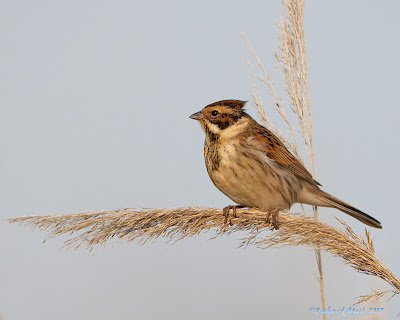
 Reedbeds are always worth looking over at this time of the year, although never easy to get photos especially if there is a breeze blowing the stems around. The reed bunting are looking at their best and the numbers of warblers are increasing.


 and a couple of shots off the reeds.
 I only managed one shot of a female on the reeds so will have to return and try and get some more, if I can fit it in now the spring migrants are starting to appear.

 Long-tailed tit


 She was flying between different reed stems and catching flies emerging from the reeds. This is a moment of take-off and en-route to the next insect.
 The other bird was a male reed bunting in winter plumage


 Posts
Posts


