Showing posts with label Goosander. Show all posts

Saturday, February 11, 2017

Winter Light

Photography is all about using light to show your subject at it best. For me, this is about using natural light as I don't use flash. Many years ago I tried some flash photography trying to capture small birds in flight and was so disturbed at the response of the birds that have not used it since. I don't have any problem with the use of fill flash during daylight for those that want to use it. However,  Aacurrent trend I find particularly worrying at the moment is photographing owls at night with multiple flash set ups at baited posts. With their highly sensitive night vision, this must be impacting on the birds with temporary blindness and their long term hunting success. Now I know there are all kinds or arguments surrounding this concerning the negative effects which I not going to enter into. All i can say is this practice seems wrong and it bothers me greatly.

For those photographers who just use natural light, winter is a very special time of year. The low elevation of the sun produces beautiful soft warm light to work  through large parts of the day. Unfortunately, living in cloudy north west England,  such days can be few and far between and so you have to make the most of them when they do occasionally arise. On occasions it can feel like an eternity of cloud between sunny moments. The other benefit of course is that it easy to get out at first light without the need to set your alarm to ridiculous o'clock, so you can have a nice relaxed start to the day and still be at your chosen site at sunrise to catch the first important rays. Even at this time of year, both ends of the day tend to produces the most evocative images.

The collection of images below are from my recent winter wanderings and in no particular order.

I have spent a little time down by the huge area of local salt marshes hoping to capture some short-eared owls. As with most photography of hunting owls it is a game of luck and whether they fly close to your chosen position. Given the size of the marsh, success rate can be fairly low and it requires many hours effort to be rewarded with only a few images. Given the time requirements, the moments when the sun is out and the owls are close occur even more infrequently.

When the sun does shine at this site in the afternoons it tends to be at a tricky angle and ranges from side lit through to full backlit.
Sat waiting by the marsh for long periods you do see plenty of other birds, particularly raptors such as hen harrier and marsh harrier although often at too far a distance for photography. Occasionally one does come closer. This is a silhouette of a marsh harrier hovering over the reeds at last light.
While waiting by the marsh, there are usually some small birds around the edge to pass the time such as Stonechat.

Another place I find myself waiting around quite a bit during the winter is one of the local marine lakes. This gets some interesting birds on it and can be good for photography as it allows in places for you to get right down at that water level perspective. However, with it covering an area of around 60 acres and having high numbers of visitors, catching the birds close to the edge requires paitence. I usually visit at first light when the number of people and dogwalkers around is low.

A Cormorant surfacing at first light.
There are usually several Red-breasted Merganser on the lake each winter.
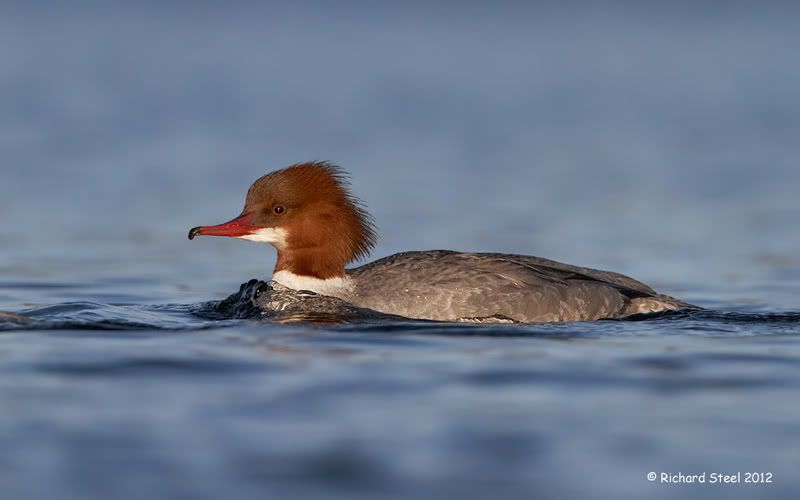
This winter they were joined by two female Goosander.
One benefit of the number of visitors is that the wading birds are relatively accustomed to people which provides some photo opportunities while waiting. In this case a Redshank in flight.
One difference this winter is that there have been very high numbers of Brent Geese overwintering on Hilbre Island off the north west corner of the Wirral peninsula. Usually they stay on the island but some have been venturing over to the mainland this year which gave a couple of opportunities to put these long distance travellers in front of the lens for the first time.


Moving closer to home. At the end of the street where I live is the River Mersey, which gets reasonable numbers of waders on the intertidal area. For some unknown reason, I rarely venture down there with a camera. To get it at its best all the right conditions need to coincide with late afternoon sun and the right state of tide i.e as the tide is coming up to high water or ebbing away leaving a narrow strip of shore for the birds. As I work from home now, a couple of weeks back the weather and tides came together for a quick mid-afternoon break from the computer for an hour. It was an enjoyable brief session photographing a foraging Curlew and some Oystercatcher picking around the rocks for crabs and mussels.


Maybe I should try and visit the end of my street more often! It is all too easy to overlook what is on your 'doorstep'. Unfortunately it does not look like the sun will put in an appearance this weekend, such is the way of winter weather, but there is more promise in the forecast for next week for maybe a quick work break session. Fingers crossed for some more of that glorious winter light to come before spring is upon us.

Sunday, January 25, 2015

Bang Bang ... Go the Goosander

My first photography session of 2015 saw me heading to an upland lake with my friend Steve. The weather was forecast to be mixed with a brisk wind and intermittent sun but looked good enough to make the trip worthwhile. We have been photographing Goosander at this site on and off now for several years but were both surprised to find our last visit was  back in 2012. Needless to say we were both looking forward to it.
After a 90 minutes drive, we arrived at the site and three things were immediately obviously. Firstly the lake level was much higher than usual and our favourite spot to photograph the birds, a concrete jetty set just above water level, was under about a foot of water. Secondly the sun was well and truly blocked out by a long line of cloud that seemed to be developing as it was pushed up over the hills and thirdly there was not a single Goosander to be seen. Not a very promising start!

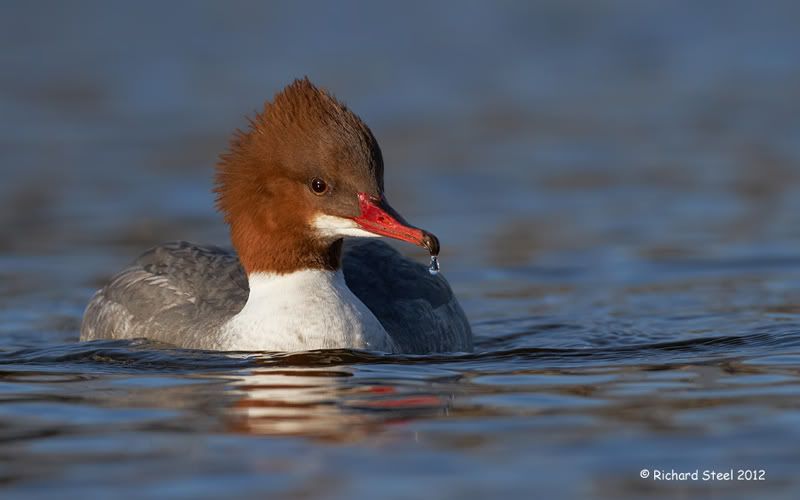
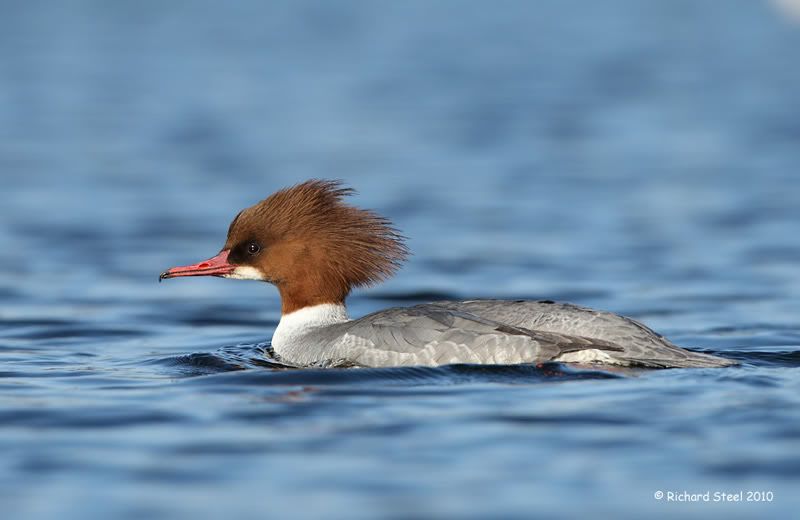
A close view of a female to show why they are called sawbill ducks.
So we waited and waited and were just thinking about perhaps looking somewhere else on this large elongated lake when a pair of birds flew in. The sun was still stuck behind the stubborn bank of dense grey cloud. We starting taking some photographs but the male birds with their dark heads with its iridescent green sheen really do benefit from a bit on sunlight.
Far in the distance the clouds seemed to be breaking and a patch of blue sky, which was heading our way, was opening up. At the same time a second pair of birds arrived. The situation was definitely improving fast and even the lake levels seemed to be dropping from its flooded state. Before long the blue sky was by us and the sun appeared and it looked like we were to have a prolonged period of good light ahead.
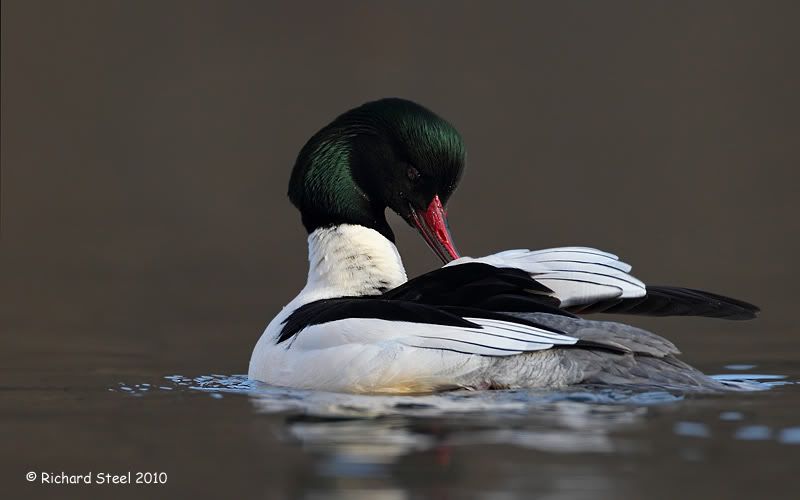
Preening male. 
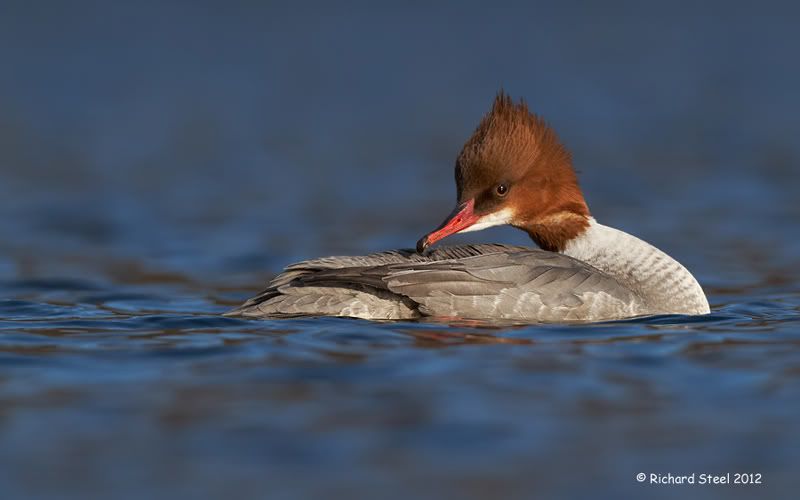
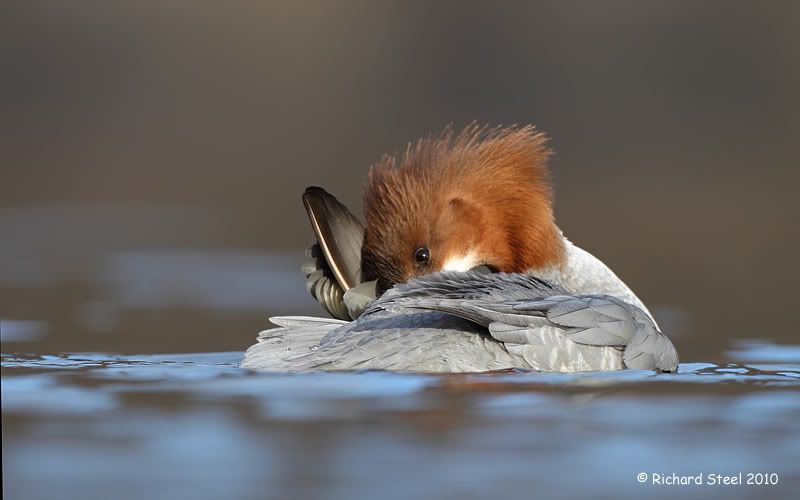
and preening female.
We had been photographing the birds for around 10 minutes when there was a loud bang, followed by another and another and another which was echoing around the hills. My first thought was that may be there was shooting party up on the hillside somewhere. The banging continued and seemed to be getting closer. With each successive bang the Goosander were obviously getting more and more unsettled. Then the source of the noise appeared which was a 'customised' small car which was constantly backfiring which was travelling down the road along the edge of the lake. By the time it had reached us, still backfiring constantly, the Goosander had heard enough and all four took off at high speed towards the far end of the lake. How typical, we had patiently waited for it all to come together only to then fall apart in an instant due to a passing poorly modified car. We could hear the car as it was driving around in the nearby town, bang, bang, bang before it eventually fell silent presumably due to the owner parking.
All we could do was wait once more to see if the Goosander would return. This gave Steve time to have a play with his new Canon 7Dmk2 and get a better feel for the autofocus with some flying mallard. As we waited for the Goosander we said that knowing our luck the birds would return and the back-firing car would come back through just as they arrived. We waited some more. Eventually one pair of birds returned. They had been there for around 5 minutes when from the town behind we suddenly heard in the distance bang...bang...bang..as the car started back up. We looked at each other in disbelief, surely we wouldn't be twice unlikely which fortunately we were not. However, by this time the patch of blue sky was rapidly closing up once more into dense cloud with no obvious signs into the distance of improvement. So once the sun disappear for the last time we decided to bring the session to an end.
A rare exit from the lake.
One the final photographs in the afternoon before the sun disappeared behind cloud for the last time
It was one of those trips where you think you have not come away with many photographs but I was pleasantly surprised when I got home and went through them. We had obviously worked hard in the moments when we had both sun and birds in front of us. Overall it was an enjoyable day out and a great way to start our photography in 2015.
Wednesday, March 28, 2012

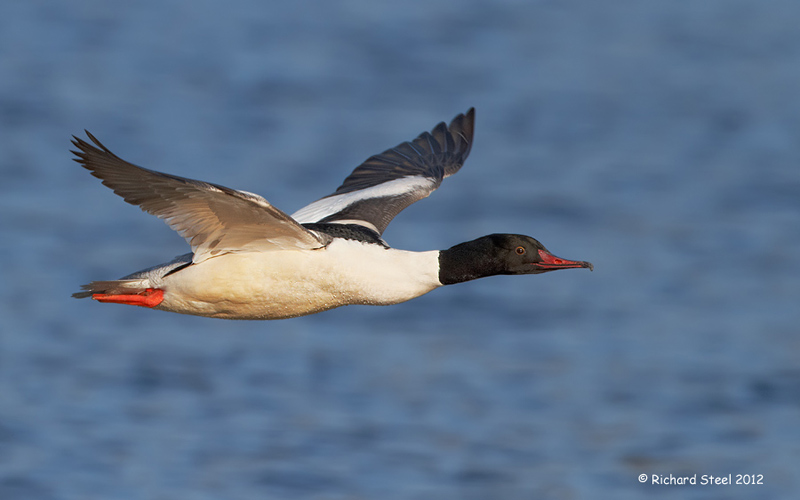
Goosander in Flight

This post is a continuation of the previous post on my trip to North Wales to photograph some Goosander on an upland lake. I have undertaken several sessions previously with these birds but never managed to photograph one in flight. This has resulted from the birds never actually taking to the wing during my previous visits. Therefore the main objective of this session was to try and capture some of those elusive flight photographs.
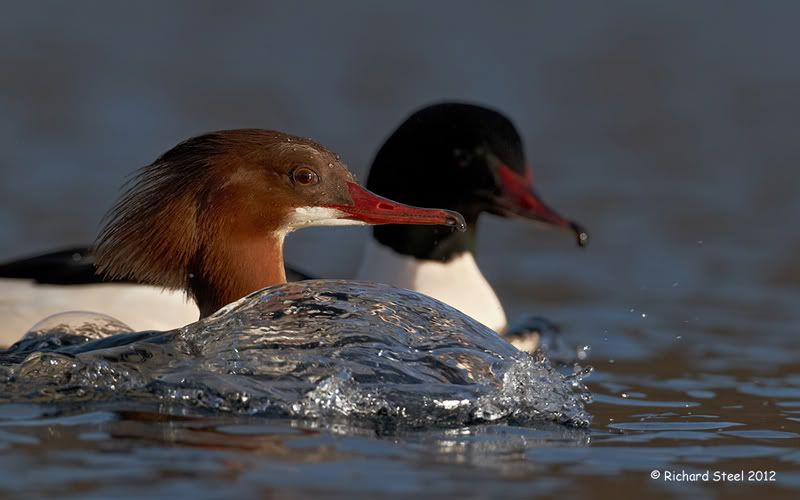
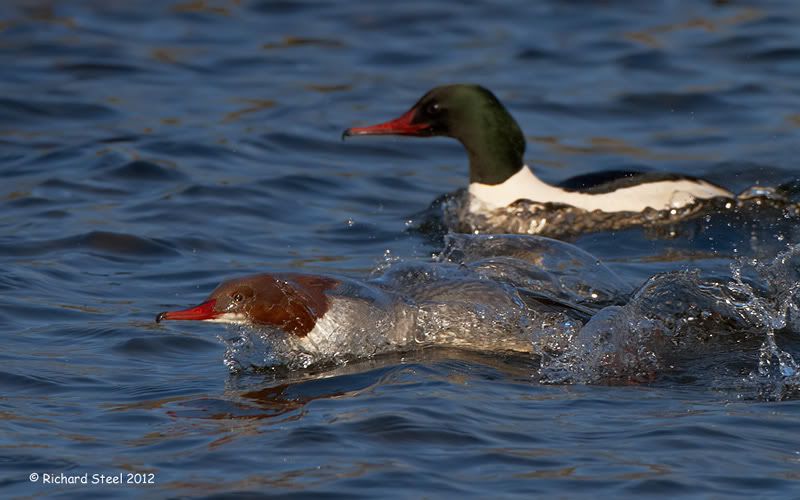
The birds seemed very active, which may have been a result of the high numbers of males creating competition and trying to impress the two females present. This resulted in the birds frequently taking flight. Just like public transport you wait ages for one to arrive and then three turn up at once.
As this was the first time I had seen the birds in the air I was amazed by the speed of their low flight across the lake. Fortunately they tend to fly in reasonably straight lines which allows time for the photographer to track the bird and the camera focus to lock on the target. It reminded me a little of photographing puffins on a larger scale. I didn't manage to take a photograph of one of the females in flight but was happy with my results for the male birds.

It was interesting to watch these birds coming in to land as not only do they use their wings and large webbed feet to slow down their approach but in the final moment dip their fanned tail into the water to provide an additional brake. Given the speed of their flight the birds have a lot of momentum to dissipate before landing.
Another thing I had not realised from previously watching the birds swimming around the lake was the width of their body which is shown on this head on approach photo of bird coming in to land.
These birds will no doubt have dispersed now to their breeding areas on the fast flowing streams and rivers that drain the surrounding hills. However, I am sure they will return once more to this lake next winter and no doubt I will join them once more for another session in attempt to capture a female in flight.

Friday, March 16, 2012

Perfect Day

Back at the beginning of February, I took a day off work for my birthday to head out for some photography. This has now become a bit of a tradition and on this occasion I arranged the day out with my two good friends Steve and Gerhard to try and photograph some Goosander. The forecast looked good at our destination of an upland lake in North Wales, with clear skies and light winds predicted. Conditions were not great locally as I drove around in the early morning coastal fog to pick them up for the trip. However, I was confident all would be well at our destination as this was similar weather to my previous visit when the elevation of the lake effectively puts it above the low lying fog.

The site we were visiting is very scenic with the the placid waters of this large lake reflecting the surrounding hills and snow capped mountains under the low winter sun.

As expected the Goosander were present but the normally female dominated flock on this occasion consisted of 7 males and just 2 females. We set about starting to take some photos. When photographing water birds the most effective images tend to be those where the camera is as close to water level as possible. This particular site has a concrete jetty that is set only a few centimetres above the lake water easily allowing this low point of view. However, it does tend to be a bit of a messy business as you find yourself lying amongst a lot of green slime and gloop that coats the jetty. I will start of with a few photographs of the females.
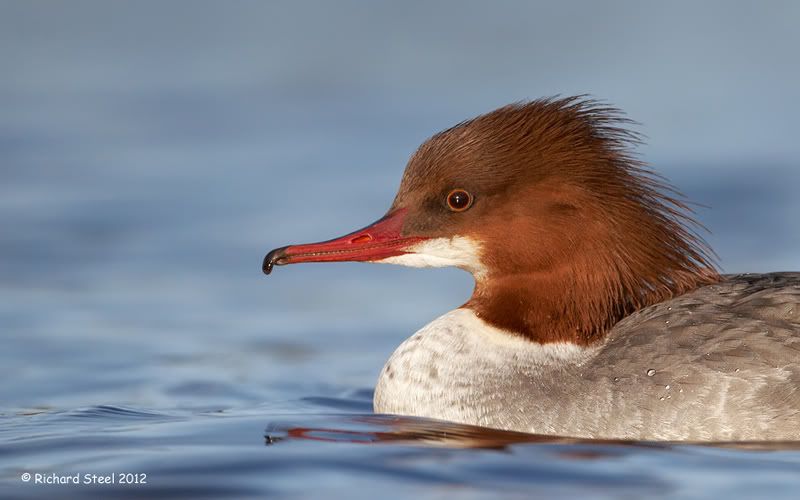
A close up of the female's head with that rich rust orange head colouring. You can see from this photo why these fish eating ducks are called sawbills. The fine teeth of the bill perfectly adapted for catching fish.
A bit of early morning preening to keep the feathers in good condition.
An attentive male bird in the background.
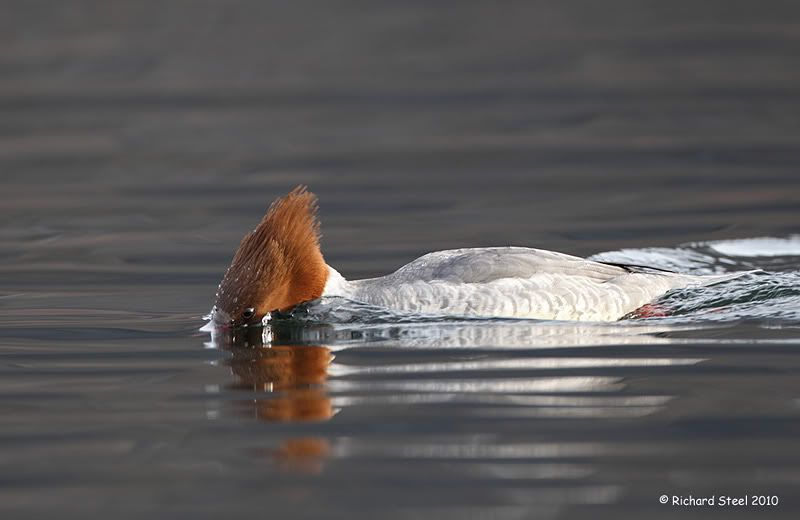
Emerging from a dive with a male in hot pursuit.
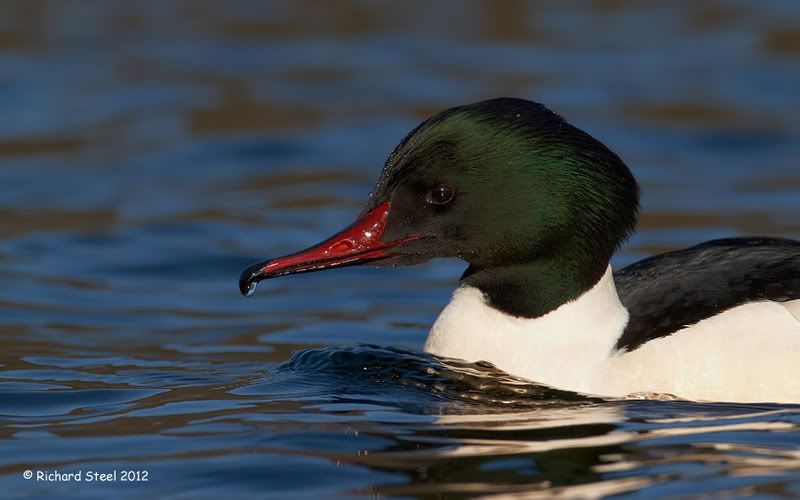
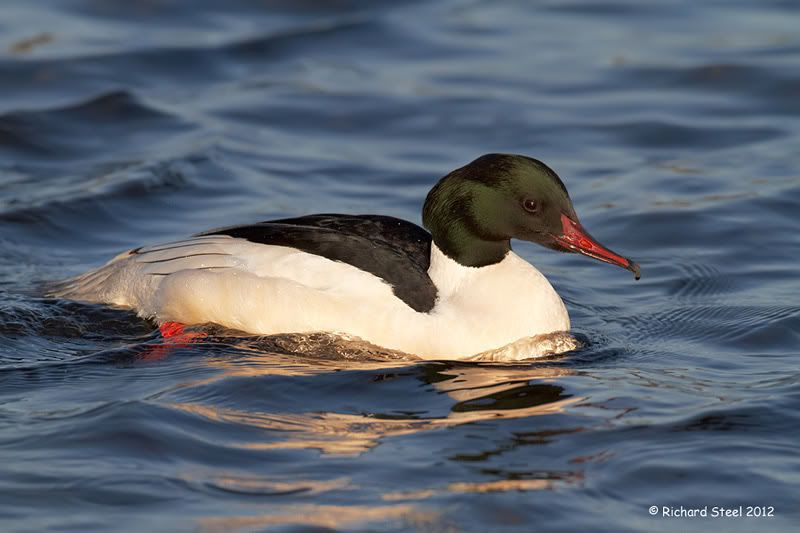
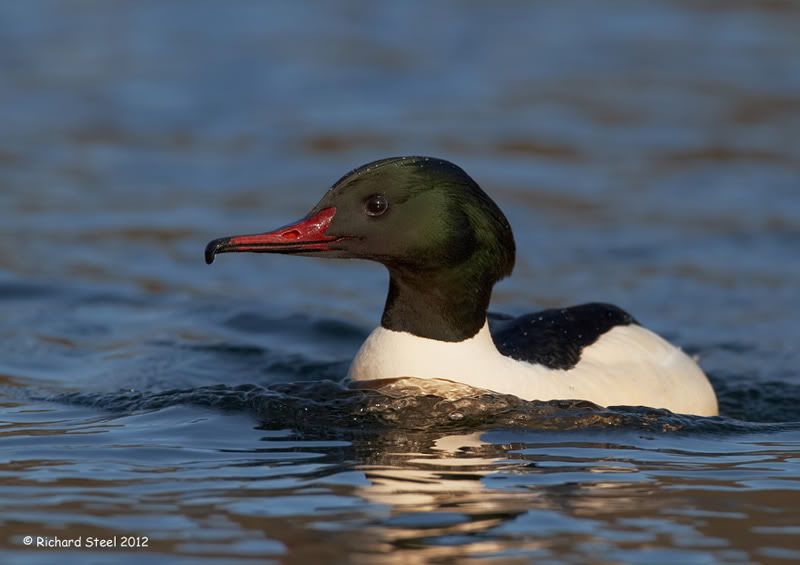
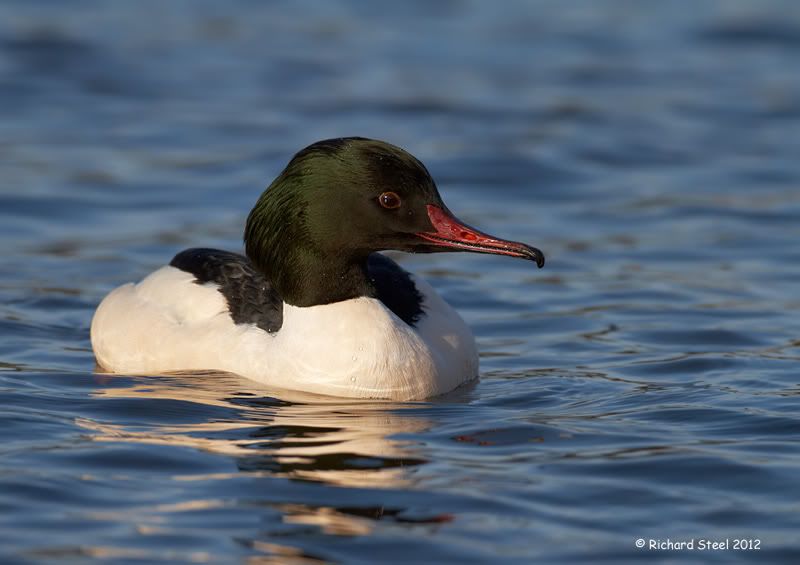
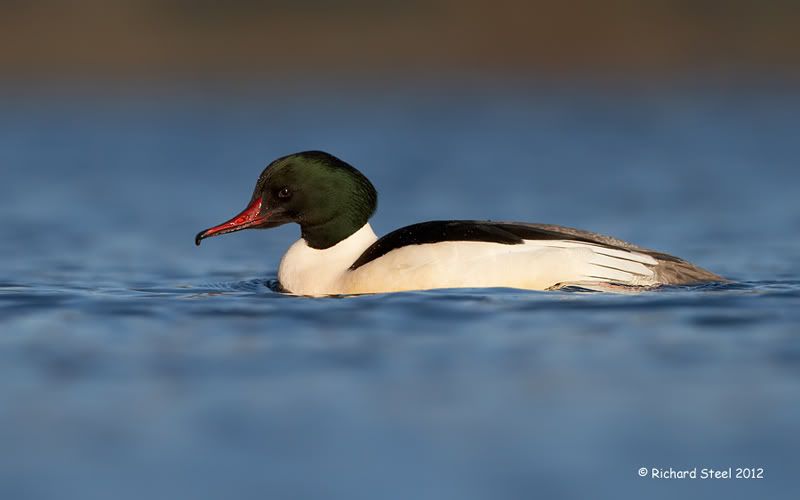
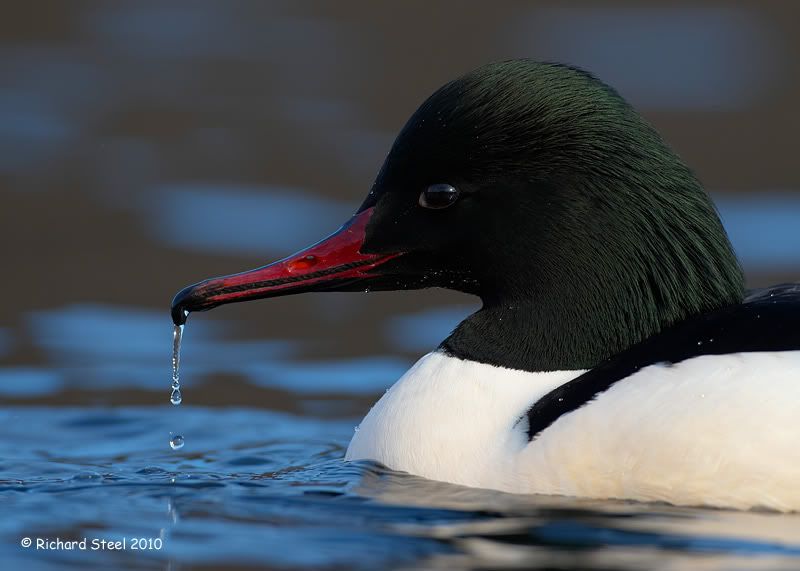
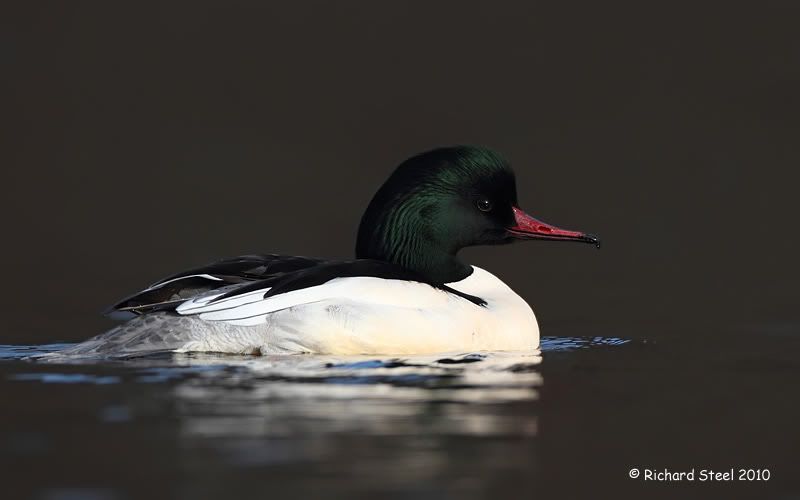
The male Goosander is probably one of the trickiest birds I can think of in terms of getting the exposure of the photograph correct. It's a balancing act of trying to keep detail in the head, which turns from black to green depending on the light angle, without over exposing the bright off white flanks of the bird. The females on the other hand are much easier to photograph with you just needing to keep an eye on the exposure of whites on the breast. The males are truly stunning in the right light.
The intimate view created by photographing at water level.
One of the main purposes of this trip was to try and get some flight photos but I will be keeping those to the next blog post and just sticking with portraits for this one.
A good day was had by all and we left in the mid-afternoon with memory cards full of images. I dropped my friends off but didn't realise that was not the last I would see of them that day as unbeknown to me a surprise meal at a Chinese resturant had been arranged for my birthday in the evening. This was a great end to a perfect day of good company in a great setting with beautiful birds in wonderful light. You can't ask for much more than that.

Sunday, February 21, 2010

King and Queen of the Sawbills

Of the sawbill species in the UK in my book the Goosander gets the top place as the Sawbill Royalty. They are such majestic and beautiful birds. I arranged with my friend to Steve to take a trip out for them and was worryingly met with a thick blanket of fog as I stepped out the front door. However, I still retained hope given that the lake where they reside over the winter is in an upland location and might be above the low lying fog. This proved to be the case as we drove down the length of the lake to find the birds with clear, sunny skies overhead and flat calm conditions. We could not find ththem at first and after a bit of searching we decided to return to where we started to find a group of 9 birds had appeared! On this visit the lake level was lower than before and had exposed a concrete boat launching pier which gave the perfect vantage point for some water levels photography.

A preening male bird
Photobucket

If you are ever looking for a bird to test your photographic exposure skills then look no further than a male Goosander in sunlight. The difficulty is trying to balance the extremely bright whites of the body with the black of the head while trying to capture some its metallic green iridescence. The other problem is that the females are so different in terms of exposure settings that it is difficult to quickly alter the camera settings between the two.
Photobucket

Photobucket

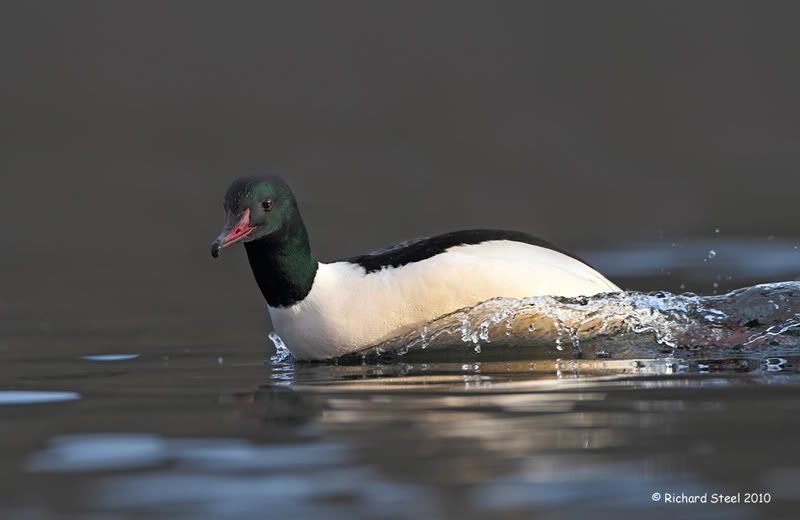
The males were starting to show some early signs of territorial behaviour as spring approaches and were occasional 'surfing' across the water at each other.
Photobucket

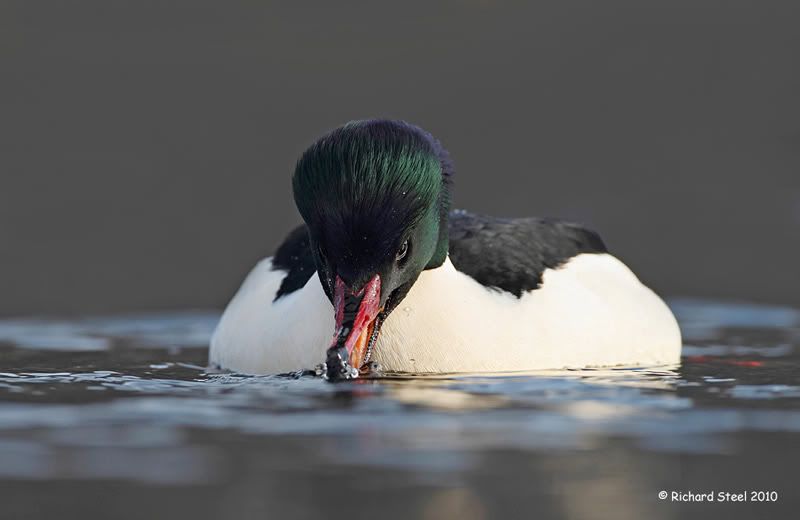
The low angle of our position on the landing stage gave opportunity for some intimate photos, although is a great way for getting a sore neck quickly.
Photobucket

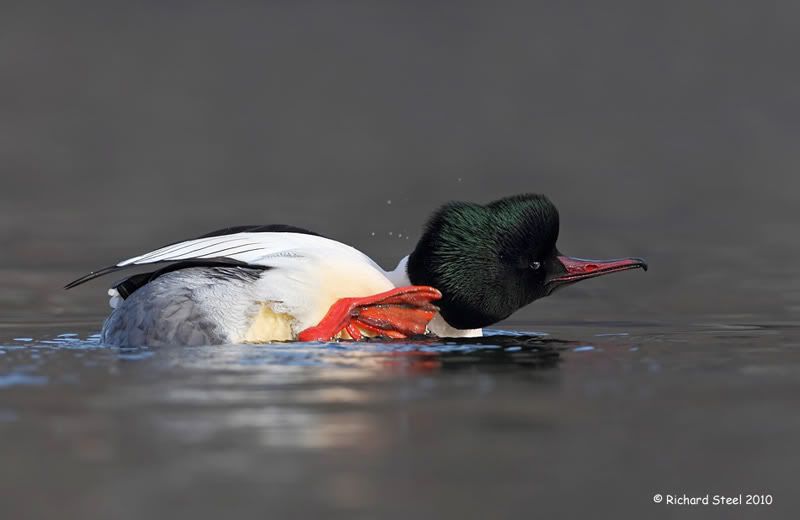
My favourite male photo of the session was of this bird in mid-preen and showing those bright orange feet.
Photobucket

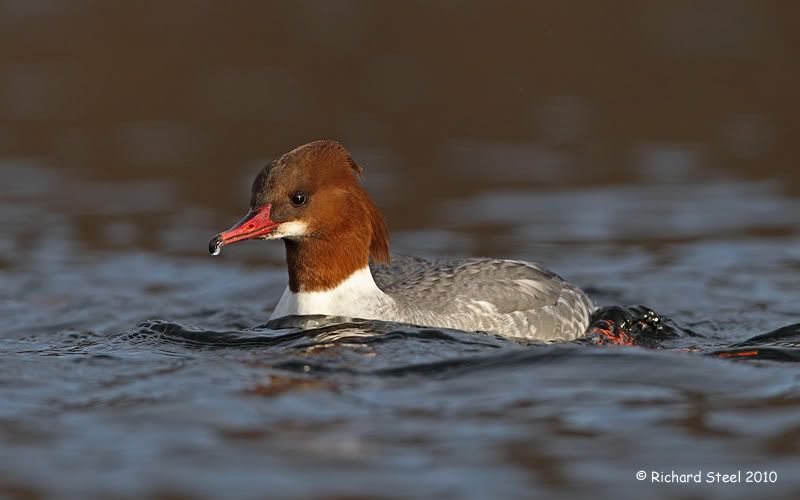
I mainly concentrated my efforts on the males but of course it was difficult to ignore the queen of the sawbills.
Photobucket

There must be a fish to eat down there somewhere.
Photobucket

Taking a rest to keep those feathers in good order.
Photobucket

The dark backgrounds of the photos above are a result of the reflection of the rising hills on the far side of the lake. Photographs taken in the direction along the length of the lake produced a blue background from the clear skies overhead which I think compliments the colours of the female better.
Photobucket

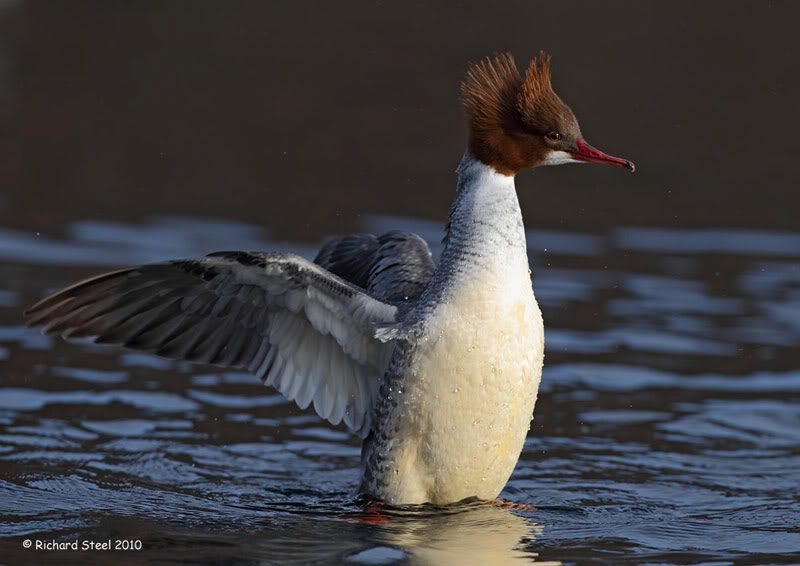
Last photograph to finish this post of a female sitting up in the water to shake her wings after a preening session.
Photobucket

A fun session in a wonderful location with cooperative birds, great conditions and good company. It does not get much better than that. As we left the lake and descended the hill we plunged back into the fog layer and so had the added bonus that photography would not have been possible elsewhere that day.

LinkWithin

Related Posts with Thumbnails