Friday, March 30, 2012

The Lark Ascending
I have borrowed the title of the famous poem and music for this blog post about Skylarks. These birds are very well loved in the UK as they epitomise an English summer's day as their liquid song drifts down from above. A song so beautiful that it has stirred many it to want to write poetry or music about them and is guaranteed to lift the spirits when heard. Often when you hear the song it can be quite difficult to spot the bird as they ascend to such great heights until they become a small fluttering dark dot in the blue expanse of the sky.  Unfortunately a sound of the English Countryside that is not as common as it once was with a decline in the population, a sad loss to the soundscape.

I have photographed this species now for several years as they show in good number along the dunes and surrounding fields along the fringe of my local coastline. However, most of these photographs have been of birds on the ground.They are not an unattractive bird but not particularly colourful.
There is a limit to what you can achieve with the ground photographs although some interest can be added by capturing the bird with its crest raised or the occasional moments they when they produce a short phrase of their song.
In my opinion one of the best aspects of the Skylark is its song flight and this is what most people tend to associate with the species. So I set myself the tricky challenge of trying to capture some in flight. This is not a simple undertaking for a number of reasons. Firstly they are a small bird making it a difficult subject to focus on but this is compounded by the time window for taking the flight photograph being very brief. The birds take off and immediately start ascending near vertically and very rapidly. Therefore a couple of seconds after take-off and your left with photographing the underside of the bird. The bird then goes into its song flight up to great heights for quite long periods of time before starting to slowly descend. However, there is little chance of photographing the Skylarks as they come in to land as they suddenly drop like a stone when they reach about 20 metres above the ground. No doubt this is behaviour to avoid predation. So the window of opportunity is limited to a couple of seconds after take-off.

I have taken some flight photographs previously but have never been very happy with them. On this session I was finally starting to get the results I was looking for as the images below filled the camera frame.
You will notice in these images that the bird is always pointing in the same direction as it takes off into the wind to aid its rapid ascent. This shows the importance of considering both wind and light direction when trying to photograph birds in flight. Even when conditions come together to capture these birds in flight it is still a difficult task for both camera and photographer.
This last photograph goes along towards catching what is to me the the essence of the Skylark as it heads upwards in full song into the blue void above. 
When my health has been fully restored after my recent illness, I hope to continue to try and capture some more images of this enigmatic lark ascending.

Wednesday, March 28, 2012

Goosander in Flight

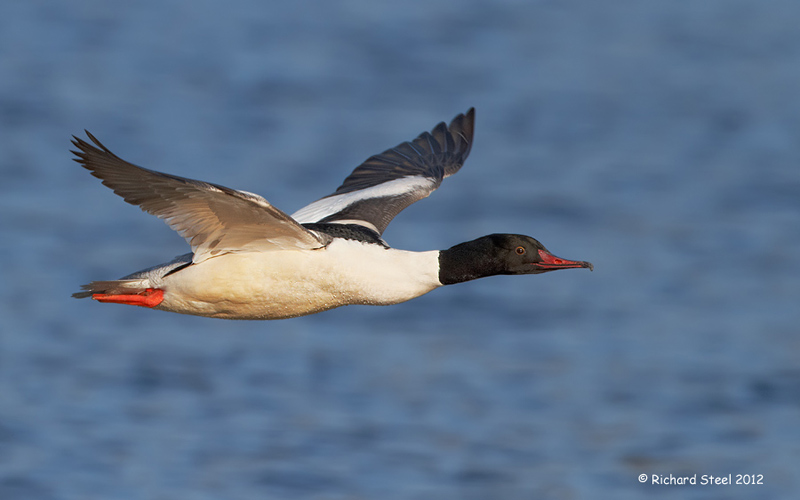
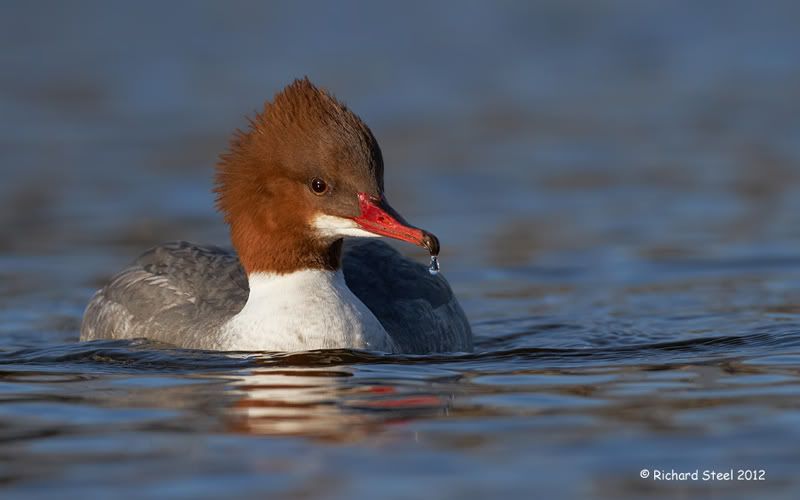
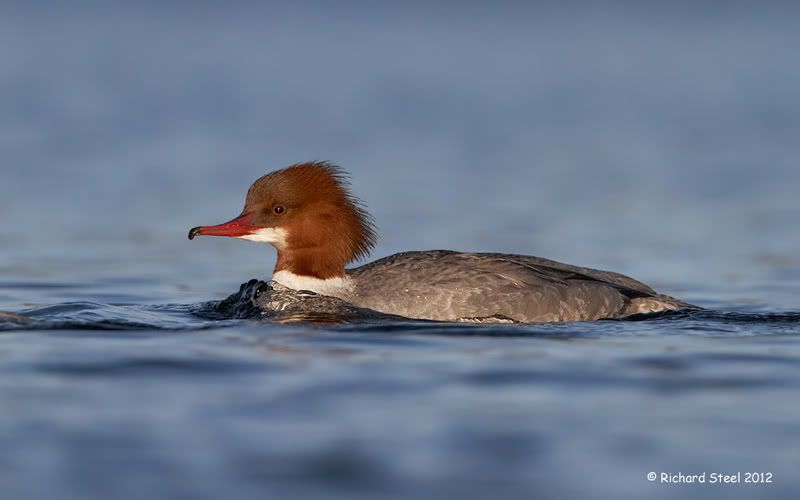
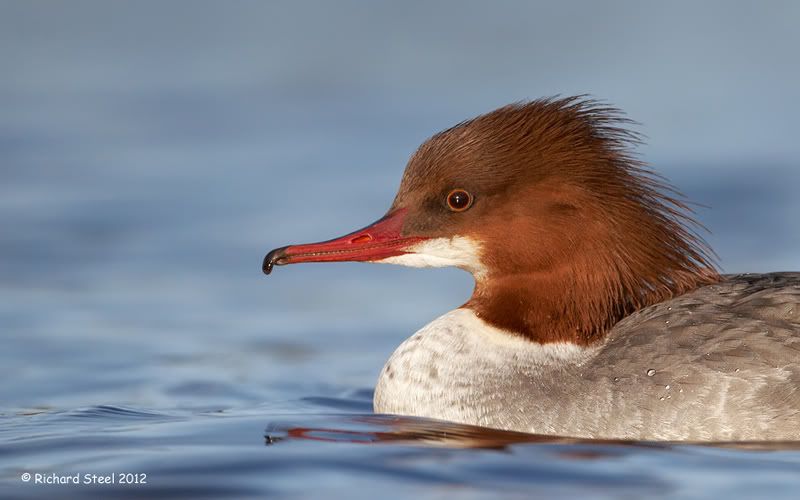
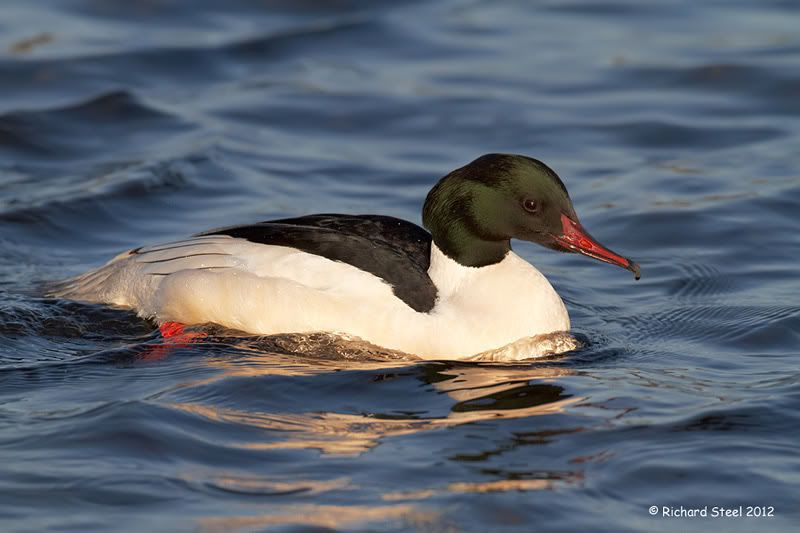
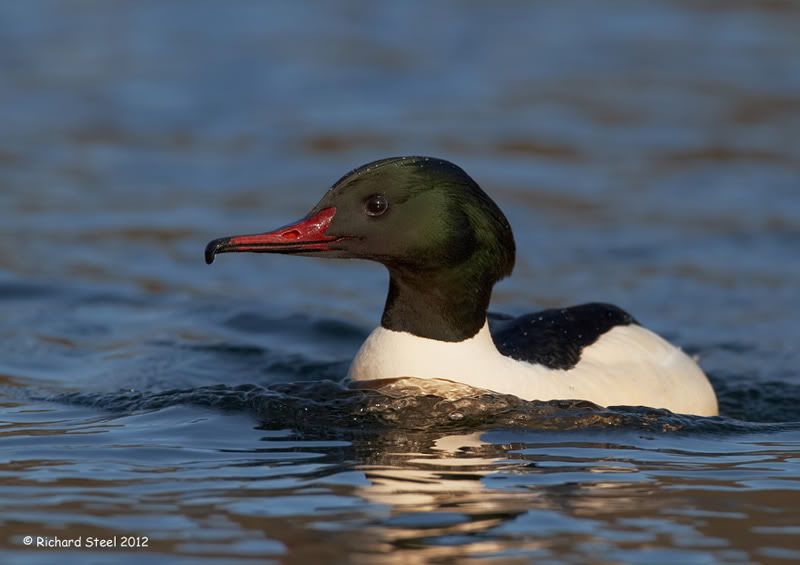
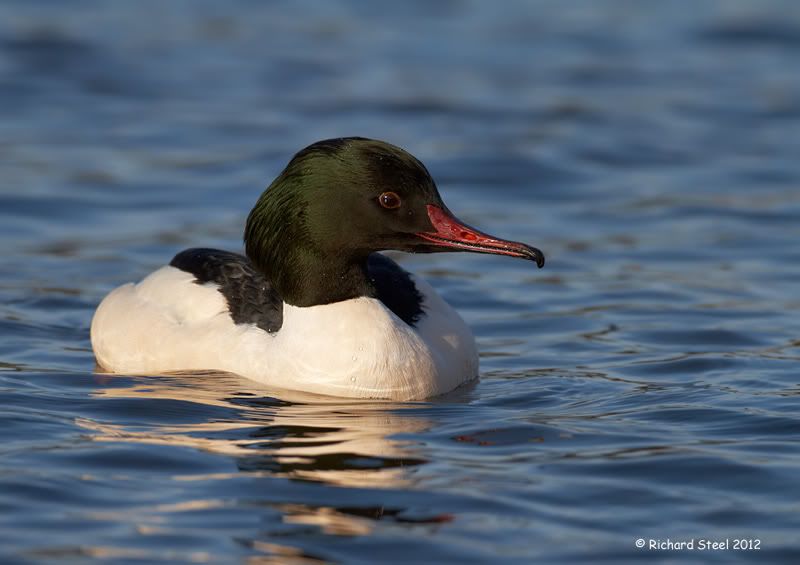
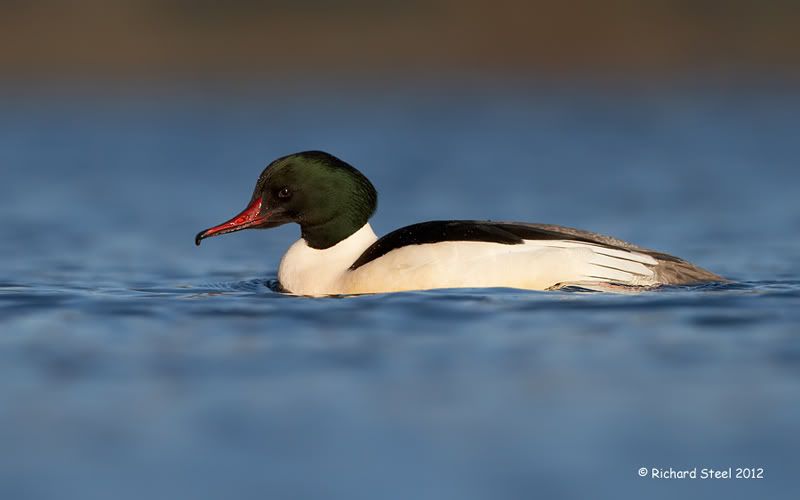
This post is a continuation of the previous post on my trip to North Wales to photograph some Goosander on an upland lake. I have undertaken several sessions previously with these birds but never managed to photograph one in flight. This has resulted from the birds never actually taking to the wing during my previous visits. Therefore the main objective of this session was to try and capture some of those elusive flight photographs.
The birds seemed very active, which may have been a result of the high numbers of males creating competition and trying to impress the two females present. This resulted in the birds frequently taking flight. Just like public transport you wait ages for one to arrive and then three turn up at once.
As this was the first time I had seen the birds in the air I was amazed by the speed of their low flight across the lake. Fortunately they tend to fly in reasonably straight lines which allows time for the photographer to track the bird and the camera focus to lock on the target. It reminded me a little of photographing puffins on a larger scale. I didn't manage to take a photograph of one of the females in flight but was happy with my results for the male birds.

It was interesting to watch these birds coming in to land as not only do they use their wings and large webbed feet to slow down their approach but in the final moment dip their fanned tail into the water to provide an additional brake. Given the speed of their flight the birds have a lot of momentum to dissipate before landing.
Another thing I had not realised from previously watching the birds swimming around the lake was the width of their body which is shown on this head on approach photo of bird coming in to land.
These birds will no doubt have dispersed now to their breeding areas on the fast flowing streams and rivers that drain the surrounding hills. However, I am sure they will return once more to this lake next winter and no doubt I will join them once more for another session in attempt to capture a female in flight.

Friday, March 16, 2012

Perfect Day

Back at the beginning of February, I took a day off work for my birthday to head out for some photography. This has now become a bit of a tradition and on this occasion I arranged the day out with my two good friends Steve and Gerhard to try and photograph some Goosander. The forecast looked good at our destination of an upland lake in North Wales, with clear skies and light winds predicted. Conditions were not great locally as I drove around in the early morning coastal fog to pick them up for the trip. However, I was confident all would be well at our destination as this was similar weather to my previous visit when the elevation of the lake effectively puts it above the low lying fog.

The site we were visiting is very scenic with the the placid waters of this large lake reflecting the surrounding hills and snow capped mountains under the low winter sun.

As expected the Goosander were present but the normally female dominated flock on this occasion consisted of 7 males and just 2 females. We set about starting to take some photos. When photographing water birds the most effective images tend to be those where the camera is as close to water level as possible. This particular site has a concrete jetty that is set only a few centimetres above the lake water easily allowing this low point of view. However, it does tend to be a bit of a messy business as you find yourself lying amongst a lot of green slime and gloop that coats the jetty. I will start of with a few photographs of the females.
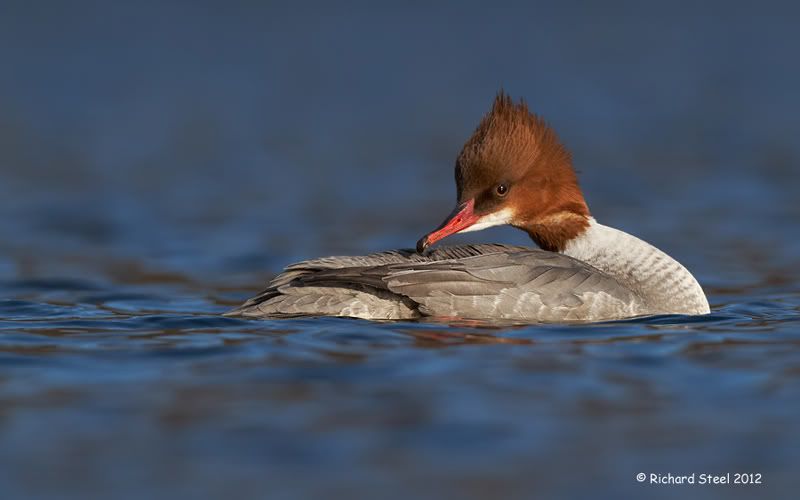
A close up of the female's head with that rich rust orange head colouring. You can see from this photo why these fish eating ducks are called sawbills. The fine teeth of the bill perfectly adapted for catching fish.
A bit of early morning preening to keep the feathers in good condition.
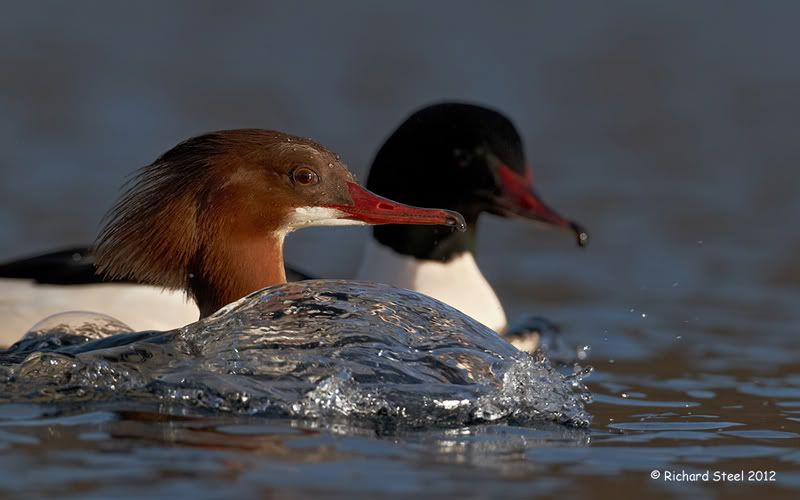
An attentive male bird in the background.
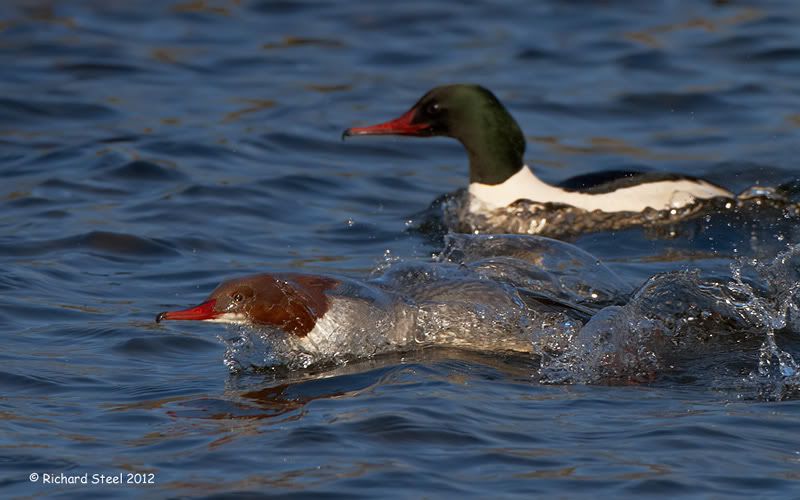
Emerging from a dive with a male in hot pursuit.
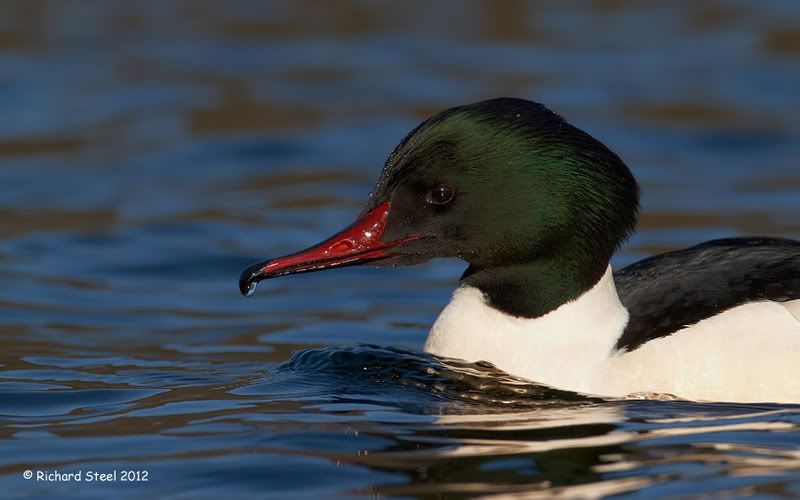
The male Goosander is probably one of the trickiest birds I can think of in terms of getting the exposure of the photograph correct. It's a balancing act of trying to keep detail in the head, which turns from black to green depending on the light angle, without over exposing the bright off white flanks of the bird. The females on the other hand are much easier to photograph with you just needing to keep an eye on the exposure of whites on the breast. The males are truly stunning in the right light.
The intimate view created by photographing at water level.
One of the main purposes of this trip was to try and get some flight photos but I will be keeping those to the next blog post and just sticking with portraits for this one.
A good day was had by all and we left in the mid-afternoon with memory cards full of images. I dropped my friends off but didn't realise that was not the last I would see of them that day as unbeknown to me a surprise meal at a Chinese resturant had been arranged for my birthday in the evening. This was a great end to a perfect day of good company in a great setting with beautiful birds in wonderful light. You can't ask for much more than that.
Friday, March 09, 2012

Dipper Time

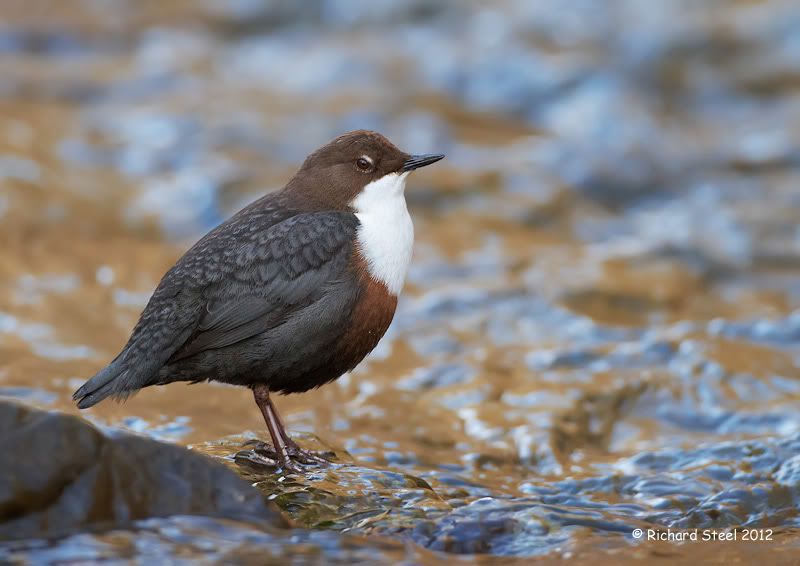
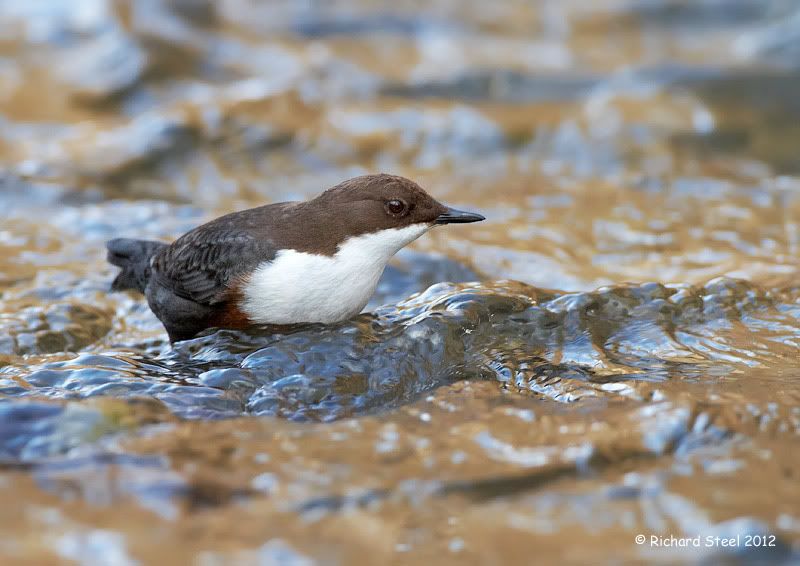
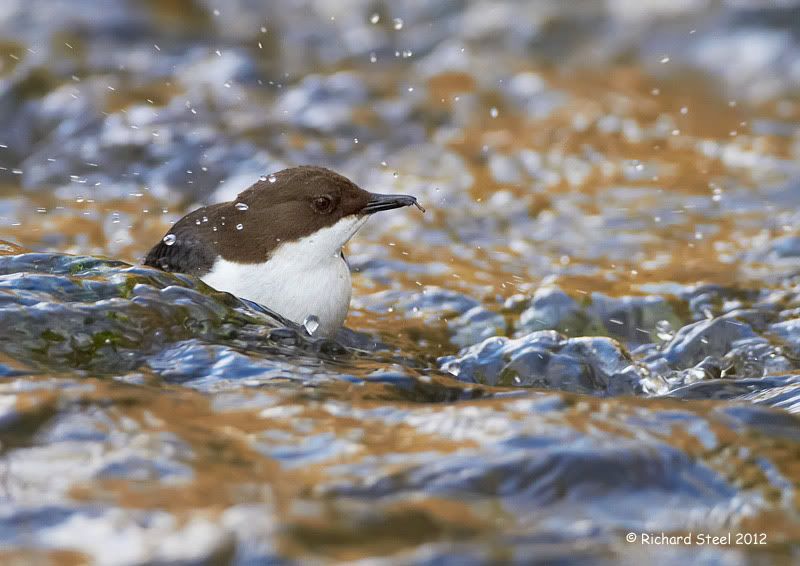
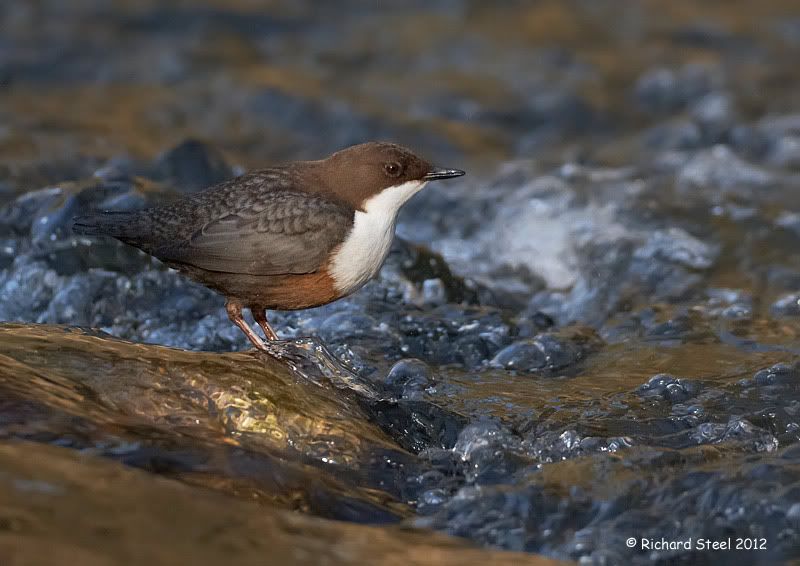
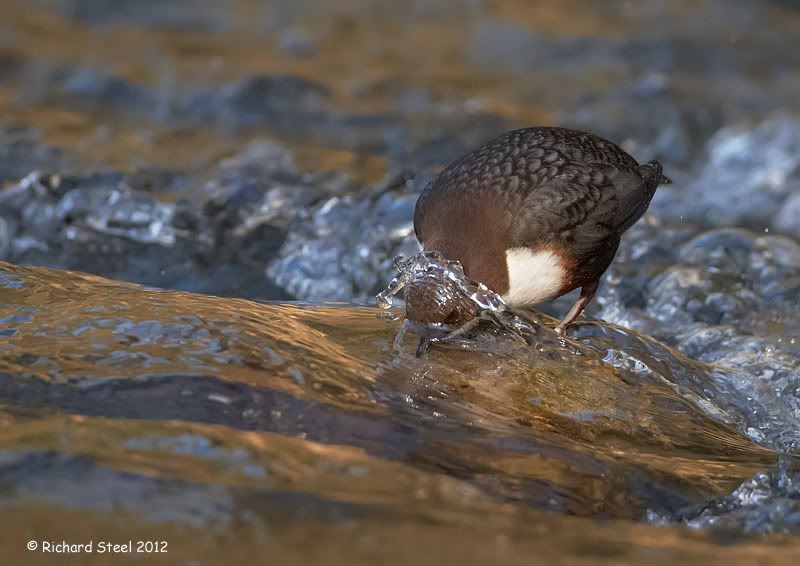
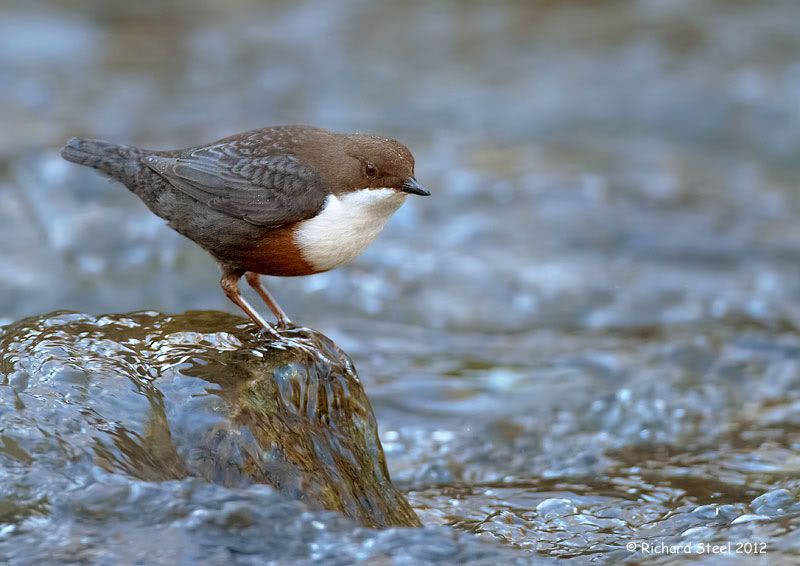
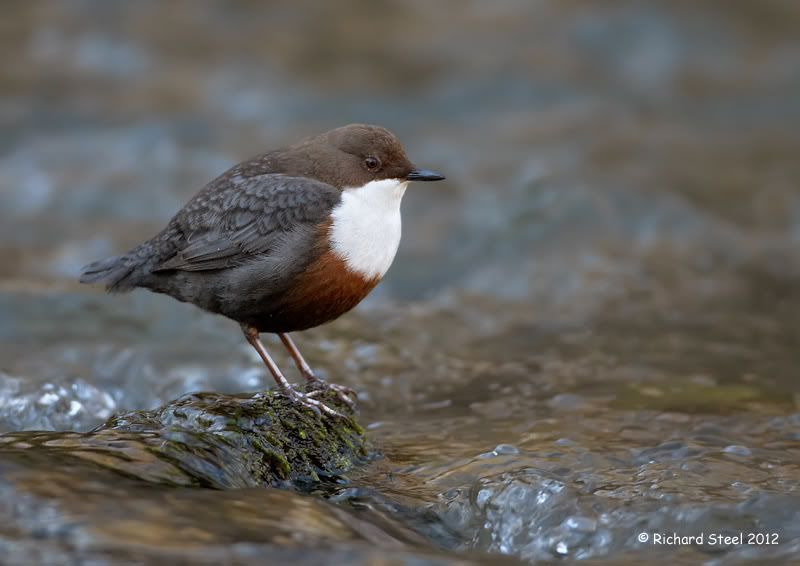
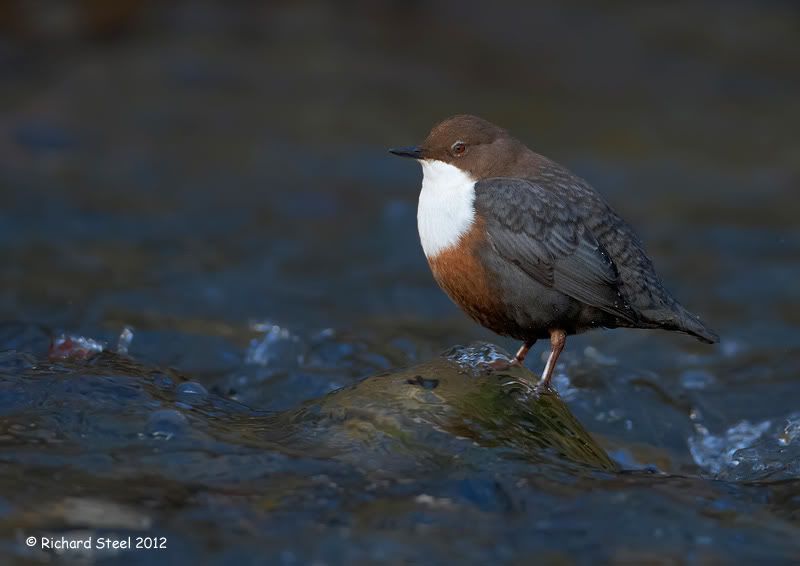
Thought I would post a few more Dipper images taken during my lunch hour sessions before I was 'struck down' (see previous post). The photos in this post were taken over the two brief sessions.
I really love these birds and can never tire of watching them dive into and hunting through shallow areas of streams for food.
It always raises a smile when I spot one of these birds gently bobbing up and down (from which they get their name) while perched on a large boulder with rushing water all around.

During my initial search for these fascinating birds I had managed to locate a pair in the upstream reaches of the stream, although one of these had a badly infected foot which from a photographic point of view did not look great. I had also briefly encountered a single bird on one occasion about half a mile downstream. During these two sessions, I managed to locate a second pair of birds that had started to build a nest below a foot bridge.
I suspect that this pair included the one I had previously seen downstream. It was good to have located a definite nesting site as it would allow me to concentrate my efforts in a more defined area for future sessions. Unfortunately just as a plan has come together they have had to be put on hold due to my unexpected illness.
I suspected given the very slow progress on recovery of my health will probably now leave it too late to return to the Dippers. By the time I get to revisit I suspect the leaves will have emerged on the bank side trees of this woodland stream and plunged it in to darkness, making any photography near impossible.
If that should be the case then there is always next year :)

Wednesday, February 29, 2012

Struck Down

Regular readers will have noticed there has been a lack of blog updates in the last couple of weeks. The reason for this is that I have been unexpectedly in hospital. There I was in work on a Friday lunchtime feeling perfectly normal and thinking about the weekend head when a searing pain developed right through my middle, all my colour drained away, I start sweating and my recently eaten lunch put in a reappearance. The pain was excruciating and I was really struggling to breathe. 30 minutes later and I was in hospital being connected up to all sorts of machines and having all kinds of needles and tubes stuck in me.

The diagnosis quickly came back as a severe acute pancreatitis, a very nasty and potentially life threatening condition. Not quite how I had planned to spend the weekend or the following two weeks! Anyway despite being extremely unwell, I am now making good process and was pleased to be sent home a couple of days ago. My brush with the grim reaper has bought home a couple of key points about life. Firstly you should really saviour and make the most of each and every day as you really never know what is lurking around the corner. It will certainly make me appreciate even more those special moments I share with wildlife. Secondly it really doesn't matter what you have in life because without your health you really do have nothing.
So please bare with me and I will returning to normal blogging activities once I have built some strength back up.
Obviously I didn't want to make a post without a couple of images, so here are a couple of Black-headed gulls that I took at the local marine lake in some late afternoon sun before I was 'struck down'.

Sunday, February 12, 2012

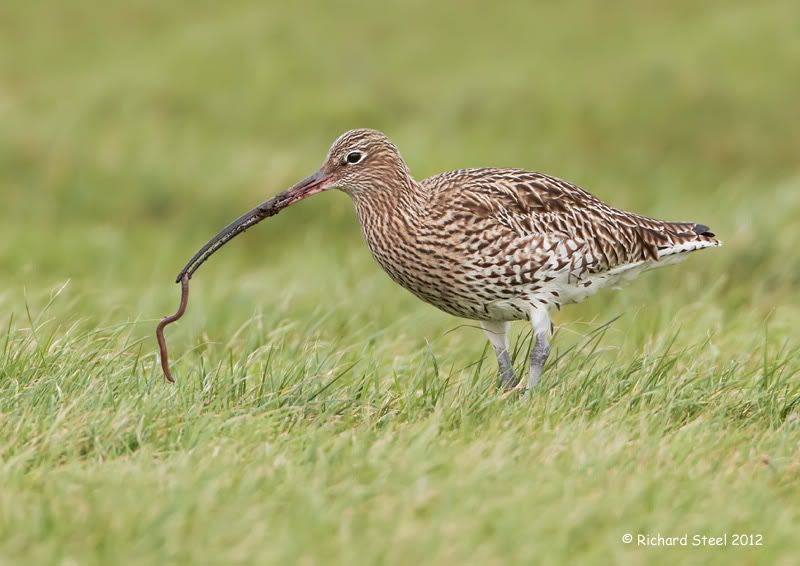
Curlew Opportunity

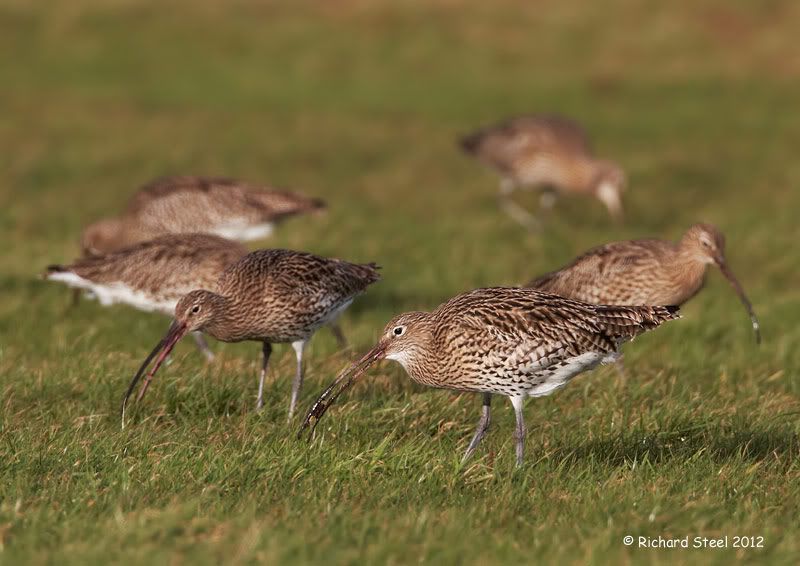
As many of the regular readers of this blog will know, I like to keep a camera by my side as often as possible to take advantage of any wildlife photography opportunities that cross my path. One such chance event occurred recently as I was driving past one of the local fields which the winter flocks of Curlew like to use during high tide to feed and roost. I suppose I was fortunate to be passing at the right time and also that the sun briefly showed on an otherwise grey and overcast day. When I first found the flock they were busy feeding but too distant for photographs of individual birds.

On the scale of difficulty of approach, I would rank Curlew fairly high. If you are on foot then they will start walking rapidly in the opposite direction long before you have managed to get anywhere within photography range. However, they don't seem to associate a car with danger and so I used mine as a mobile hide. This was one of the rare occasions when some dog walkers actually helped me photograph the birds. Two appeared on the far side of the field and the immediate response of the birds was to start walking in the opposite direction but in this case it was towards me.
It is always a great feeling when your subject starts getting larger and larger in the viewfinder as not only do you know the photographs will improve with each step but also the fact that you get opportunity to observe the birds at close quarters.
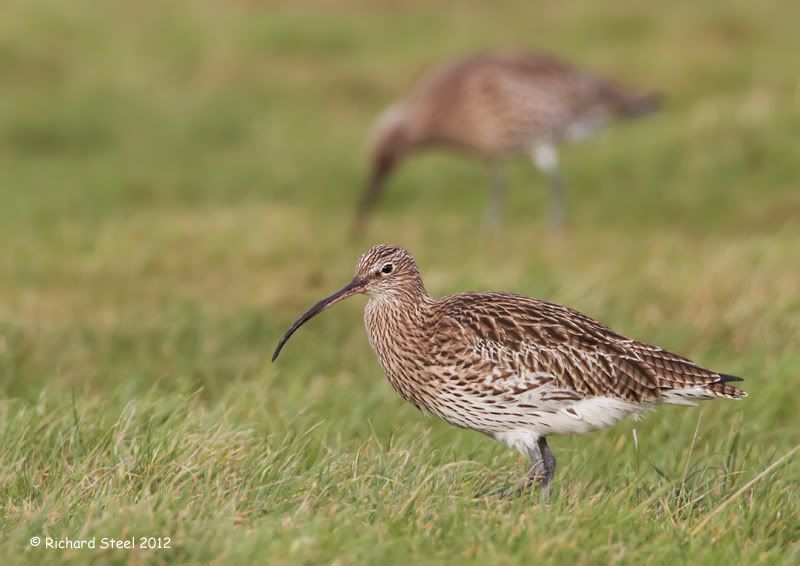
Despite staying alert to the now distant dog walkers the birds continued to feed on earthworms. No earthworm within 10cms of the soil surface is safe from that long elegantly curved bill.
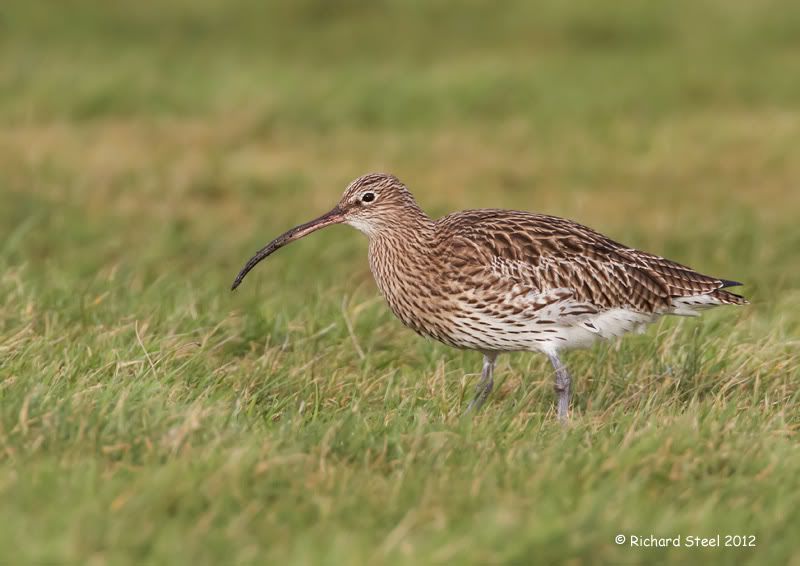
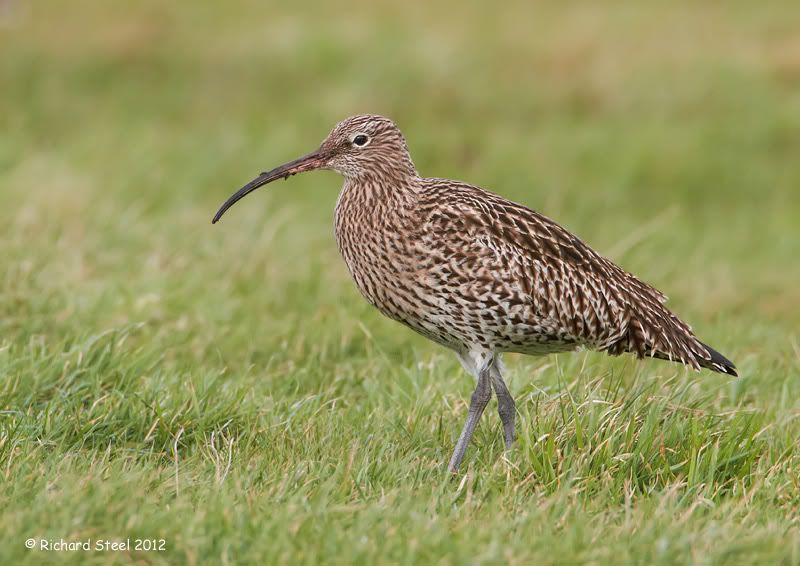
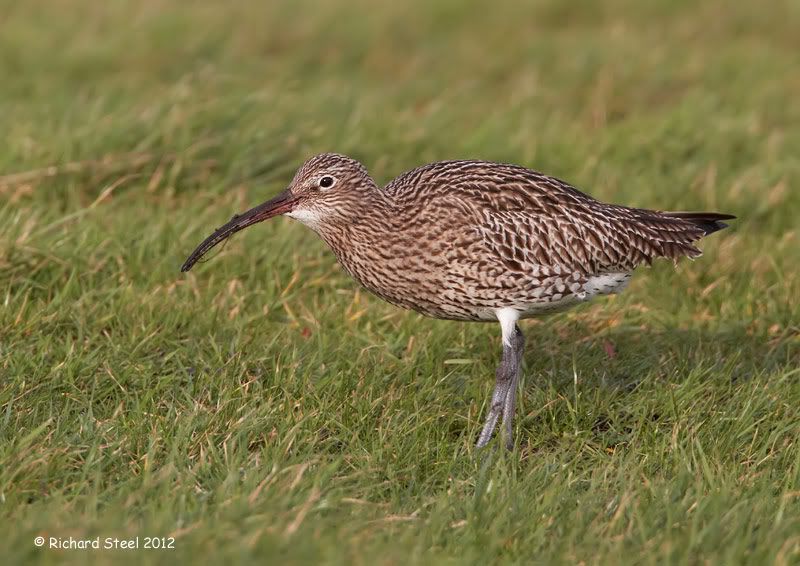
Still the birds came closer and were now completely filling the frame. You will notice that there is a large difference in bill length between the bird in the photograph above and the one below. If I am correct I believe the females generally have the longest bills.
The sun even managed to put in a brief appearance while the birds were at close range.
The brief 30 minute session ended as quickly as it had begun, firstly as the sun disappeared behind a dark mass of cloud that stretched to the horizon and secondly by a cyclist who passed on my side of the field and caused the flock to take flight and land in the middle of the field and out of camera. I always love these unexpected opportunities, regardless of how brief and they certainly brighten the day. Hopefully the year ahead will offer many more chance encounters but when and with which bird or mammal will have to remain a mystery until it takes place.

Monday, February 06, 2012

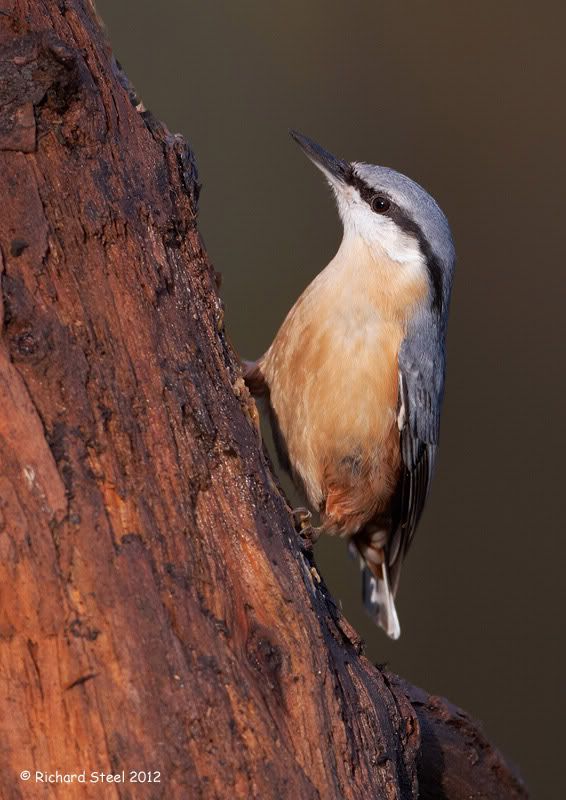
Nuthatches and nearly Stock Doves

Disaster struck recently when my main camera body developed an electric fault and died. So while its back at Canon being having various bits of electronics replaced, fortunately still just under warranty, I have had to revert to using my Canon 7D. The 7D is really the camera I reach for when I am struggling for reach and distance, given the advantages of its 1.6 crop sensor, and usually involves having a teleconvertor attached which tends to degrade image quality a little. So I am not particularly fair to this camera which can produce good images even though they tend to have more noise and lack the 'polish' of files coming out of a Canon 1D body.

With 7D in hand I recently headed out to some local woods with a view to photographing some Nuthatch and Stock Doves. This is one of my favourite woods as the rust coloured carpet of fallen beech leaves create some wonderful colours under low winter sunlight. However, lighting is always tricky and constantly changing in the rising early sun. An area that was bathed in beautiful light one moment can be plunged into dark shade 5 minutes later.

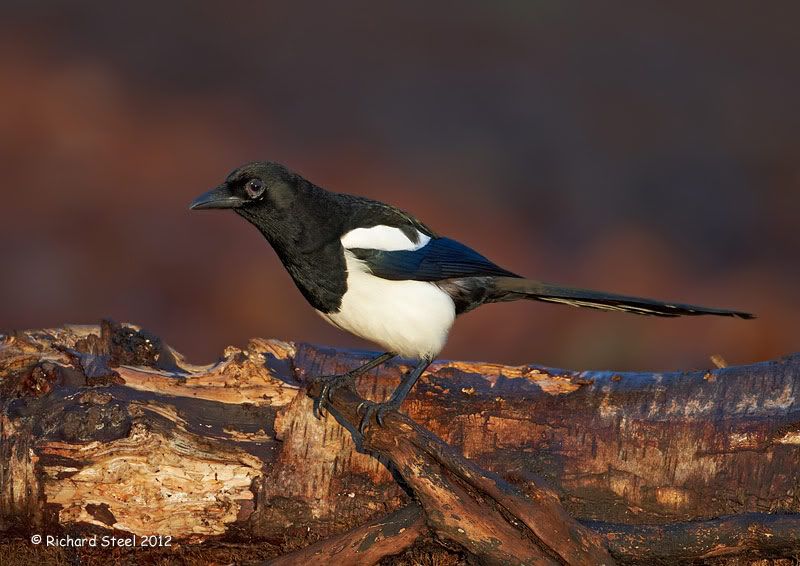
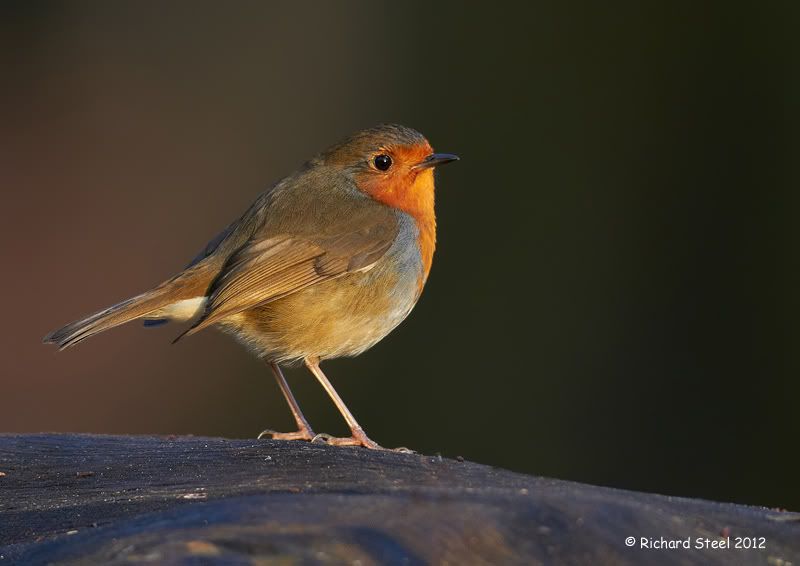
While waiting for the Nuthatches, which I could hear calling loudly above, a few other birds appeared in front of the camera and it seemed a shame to waste the good light. These included a lone Magpie, and inquisitive Robin.
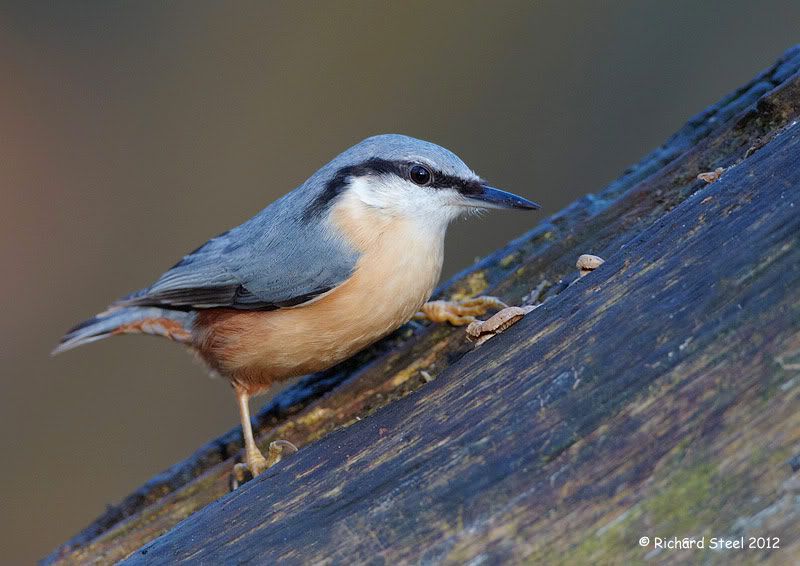
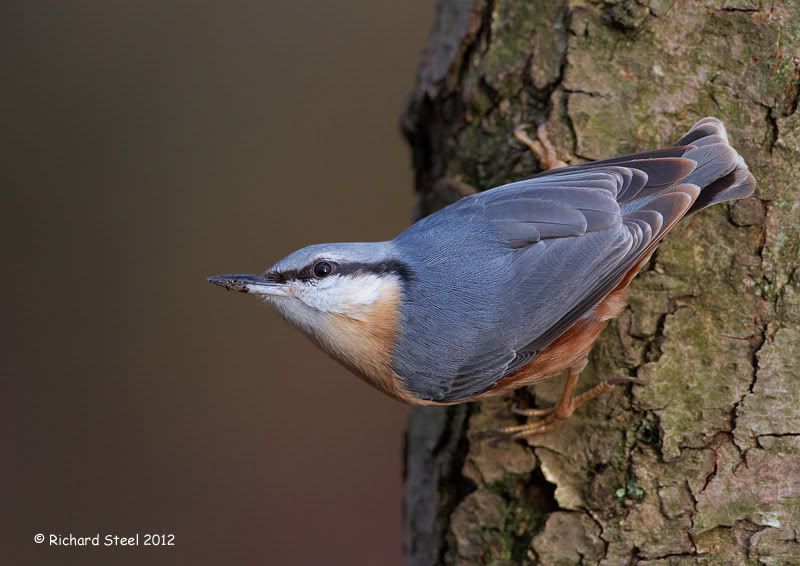
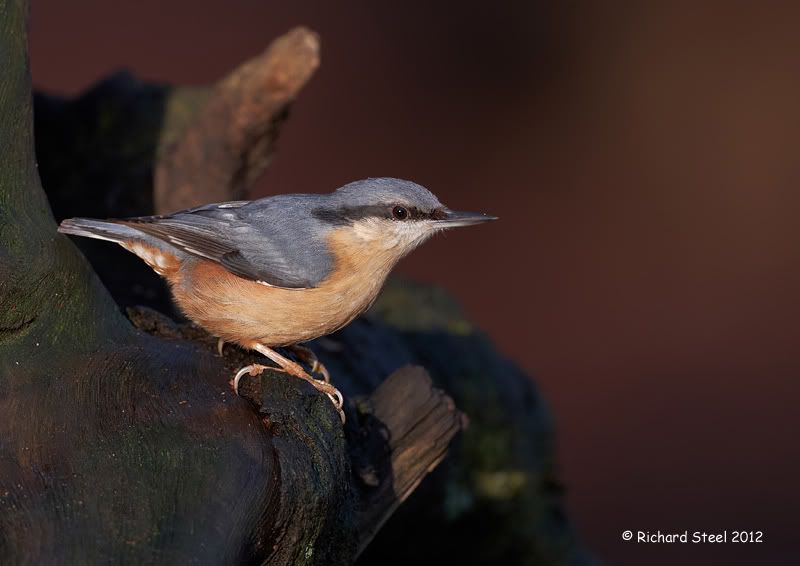
Eventually the first Nuthatch appeared. They are not the easiest birds to photograph as they tend to appear from all directions, quickly grab any available food and fly off to hide it in one of their 'larders'.
These attractive little birds are incredibly agile and always busy as the scurry around tree trunks and fallen dead trees looking for food.
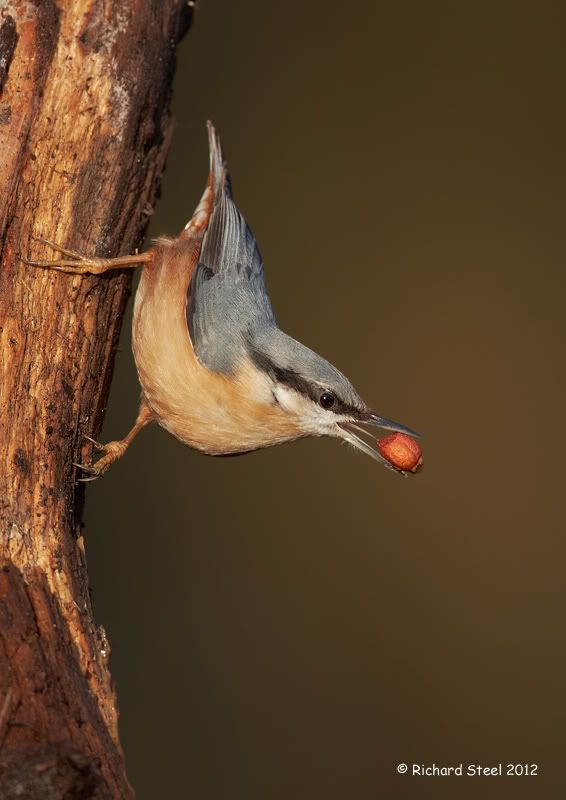
Usually when photographing birds coming into feed I tend to try and take photographs without the birds carrying food. However, a Nuthatch carrying a nut somehow seems appropriate. This birds showing a very typical inverted pose.
As I was photographing the Nuthatch I heard some fluttering and cooing high in the trees above as the first Stock Dove started to gather. I carried on with the Nuthatch.
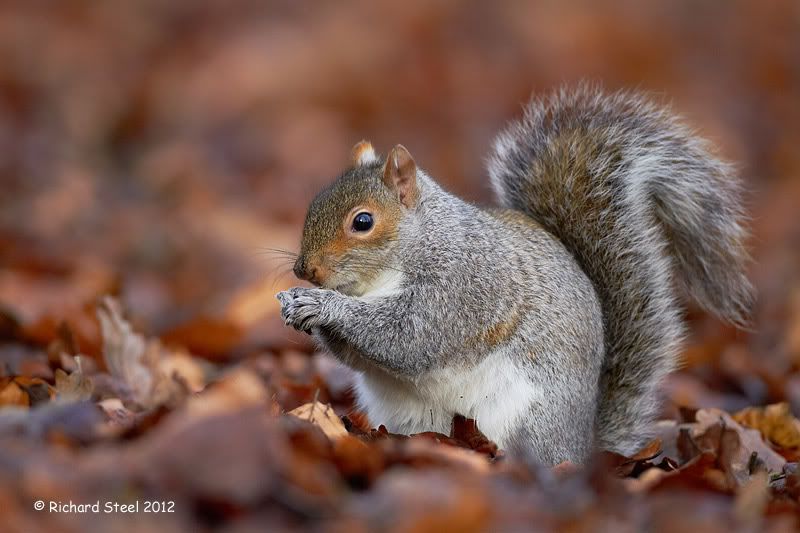
I decided it was time to move in to position for the Stock Doves as they slowly made their way towards the lower branches and the ground. They are quite nervous birds so usually you have to wait for them to come to you. A few squirrels had gathered so I filled in the waiting time with a few photos while laying in amongst the leaf litter.
No sooner had the first Stock Dove just landed in front of me, when I heard a galloping of rustling leaves and panting breath behind me and a very large drooling dog appeared. Squirrels and Doves immediately scattered, with the birds never reappearing. This was slightly frustrating as this area of woodland is fenced off as a 'No dog Area'. I obviously blame the owners (as dogs obviously cannot read), and it never ceases to amaze me how oblivious some walkers become, particularly to wildlife photographers, when exercising their four legged friend.

LinkWithin

Related Posts with Thumbnails