Thursday, August 08, 2013

Roaming in Romania - Day 6: The Macin Mountains

Another very early alarm call pushed me out of the bed. It was quite strange to hear the sound of occasional traffic outside rather than a chorus of frogs.  After a brief bit of stumbling around my room to gather my belongings I headed down to the hotel reception, where I had chance to grab a quick coffee before boarding the minibus with the other three photographers. Our destination today was the Macin Mountains. After about an hour we turned off the main road and headed up a dusty dirt track across a patchwork of flat farmland to finally come to a stop at the lower slopes of the mountains.
Our plan for the next two day was that we would split into two groups with two sessions in a drinking pool hide, the only fixed hide of the whole holiday, and two sessions going round the farm tracks seeing what birds we could find. Hans and Michael took the first hide session while Rene and I headed off in the minibus with Zoltan.

As we travelled down the dirt track away from the hide, the occasional Corn Bunting could be seen flitting between song perches and Isabelline Wheatear dashed on to the track to grab an insect. I noted there were a few puddles on the track from recent rainfall. The first bird we managed to put in front of the lens was a Short-toed lark quietly calling from a large boulder in the early sunlight.

We carried on along the dust track for a while before we heard the ubiquitous cuckoo call and decided to stop for a while as Rene was keen to get some photos of the three birds that were preoccupied  chasing each other around.

By the time we had finished with the cuckoos the sun was well and skyward with the light becoming increasing harsh. However, more importantly and has been my experience of photographing on farmland previously, a heat  and water vapour haze was very quickly developing. Heat haze is a major cause of people thinking  their camera has malfunctioned as the wobbling air can make it very difficult to produce sharp images. This was well demonstrated as we came across a perched European Roller but the images all went in the trash. There are only two approaches for these conditions which are to pack up or to get very close to the birds to reduce the amount of wobbling air between you and them. Even if you can get very close there is still a need to take a lot of images as a good proportion of them will not be sharp.

The next bird which we managed to get very close to was the familiar sight of a Goldfinch which was busy pulling apart a globe thistle seed head.

Onwards down the track and we came to a small section  that was relatively busy with birds including Tawny Pipit and a new species for me, the Crested Lark. The latter is very similar in an appearance to a Skylark but with a permanently erect head crest.
Conditions were getting more and more difficult and after a failed attempt to find an Ortolan Bunting we finished the session with a close encounter with a singing Corn Bunting
.

The dry dusty farmland with its assortment of sandy coloured birds was a stark contrast to the lush vibrancy of the Delta that we had recently left. We returned to the hide to collect Michael and Hans who reported a very slow morning with only a Turtle Dove and out of condition Hawfinch showing up. The drinking pool hide at Macin can be very productive particularly during prolonged hot and dry conditions. However, the puddles on the tracks were a sign of recent rainfall providing the birds with other places to find essential water.

We all headed off into Macin to check in to another hotel where we would fortunately only be staying for one night. To say the hotel was very grim is an understatement. My door lock was hanging on by a single screw having obviously been forced open on several occasions. Certainly somewhere to sleep on top of the bed covers with your boots on to prevent being eaten alive by the mattress wildlife and also allow a quick exit if needed. Everyone quickly decided it was not the place to leave any camera equipment which would now stay with us for the rest of the time in Macin.

We had a pasta lunch outside of a roadside restaurant before heading back to the farmland and hide. Rene and I were dropped off for our afternoon session. For those of you not familiar with a drinking pool hide it is basically an infinity pool for birds with a hide at one end. The design of the pool tends to force the birds to visit the far end and the low set hide allows photography near water level.

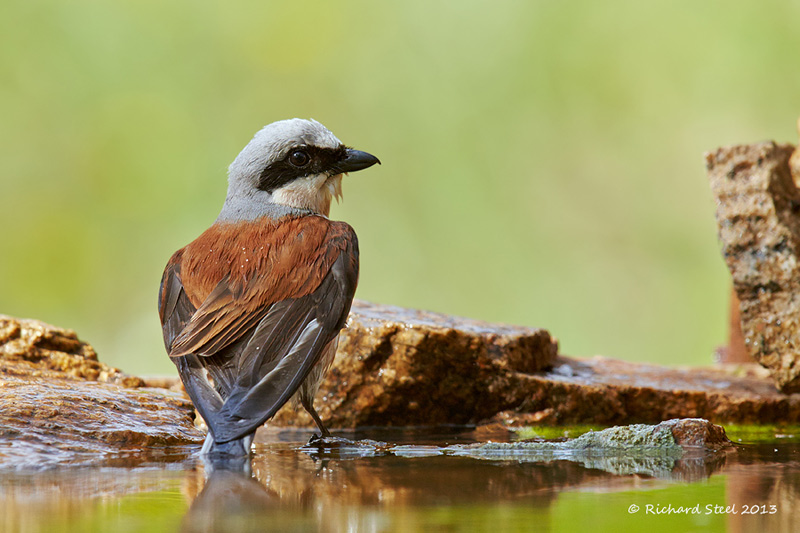
As we sat and waited in what felt like a mini-sauna, there were sounds around would have been a delight to any bird lover's ears. In the tree behind the incessant calling of cuckoo and gentle purring of Turtle Dove, to the left the metallic jangle of a Corn Bunting, in the large distant tree ahead the flute-like calls of Golden Oriole and in the bush to the right the scratchy warbles of a Red-backed Shrike. In front of us to photograph....nothing. Eventually a bird appeared in the shape of a male Ortolan Bunting, a promising start. The attractive bunting stayed for a while on a small perch before deciding it was safe to bathe.

Another hour past with no signs of birds except the occasional flash of a male Golden Oriole chasing away a cuckoo. The next arrival was a Corn Bunting which paused briefly before getting down to the important business of cleaning its feather.

After the bird departed we were forced into a prolonged wait once more. We sat there hoping that a Golden Oriole might come in to bathe but it never happened. The arrival of the next bird did jolt us from our late afternoon lull, a stunning male Red-backed Shrike which has been there the whole afternoon just out of sight in the bush to our right. For me this was definitely bird of the day.

A Jay was the next visitor. When these birds decided to get a bath they don't mess around and soon the bird was completely soaked.

The final bird to arrive was a Turtle Dove. These are such beautiful birds but under so much pressure across Europe from intensive farming and hunting pressures. In the UK, this once common bird, is very sadly rapidly heading towards extinction as a breeding species. Efforts are being made to try and help the species in the UK but I wonder if the external pressures are too great and it is too little and too late to save this attractive dove.
That was the last bird which visited and we soon heard the rattle of the white minibus returning to collect us. Overall it had been a reasonable day but fairly slow, particularly in the hide where long periods of inactivity were punctuated by the occasional bird. We went straight for a meal before heading back to the 'roach motel'  where I quickly fell asleep on top of the bed still wearing my boots.

Sunday, July 28, 2013

Roaming in Romania - Day 5: Return to Terra Firma

We had one remaining session on the Delta before leaving and starting on the land-based part of our Romanian tour. Over breakfast it was agreed we would finish the Delta photography on the small productive lake where we started and have another attempt at photographing the Black-necked Grebe in some dawn light. A 30 minutes boat journey through the overgrown back-channels found us once again on the familiar small lake.

Before I show the photographs from the session, I want to change topic slightly and mention frogs. Throughout our stay on the Delta the air was filled with the constant chorus of singing frogs. They are everywhere you go in very large numbers and a key component of the food chain for the larger water birds such as herons and egrets. During quieter spells when we were waiting for birds to come close to the hide boat, I often found myself taking a few frog photos to pass time. A small selection are below:

We had no sooner entered the lake and we came across a Night Heron, standing statue like in the soft dawn light.

The boat was skill-fully manoeuvred once again back into position to photograph the Black-necked Grebes. These attractive small water birds seemed less approachable on this particular morning than they had during our first session and the reason soon became obvious.
During the intervening period some of the chicks had hatched and were being carried around on the parents backs until they became a bit more independent. Naturally we kept a good distance from these birds to prevent any disturbance and stress. A truly wonderful site to watch the adult grebes cruising around with the next generation hitching a free ride, with the bonus of a few photographs as well which were to be our last from the Delta.

Note in this last one there is more than one 'passenger'. In fact there were three  on board. 
We finished the morning session with attempts at both cuckoo and kingfisher, both of which failed to produce any photographs. We did see the Kingfisher on this occasion though, which was diving in to the water slightly upstream, a plunging electric blue flash. Again a pleasure to watch the master 'fisherbird' at work. So our Danube sessions had come to an end and we slowly made our way back to the hotel for a quick bite to eat and to collect the rest of our luggage.

The Danube Delta has left an indelible mark in my memory. Never I have a been to a place where the raw beauty and productivity of nature has been so evident. The sights, sounds and smells of the Delta invokes a sensory overload and you find yourself quickly drawn-in and then completely immersed in the place.  I could have happily spent a month there drifting in a happy daze around the waterways and lakes. The visit also reinforced to me why the preservation of these large natural wetland sites is not just important but essential.  

In the early afternoon we left Mila 23 to head upstream back to some 'terra firma' at Tulcea. It felt like we had been in the hide boat for weeks rather than just a couple of days. The 90 minute journey into the Delta turned into a 5 hour boat ride out as we had to battle against the swift flows of the irrepressible River Danube. En route we passed several  floating hotels that were being towed upstream by small tug boats whose engines were straining to pull that floating mass against the flow and bellowed clouds of exhaust fumes from their funnels. The tourists on the upper deck seemed oblivious to this trail of diesel fumes that seemed to envelope them as they sipped long cold drinks. We were returning back to 'civilisation'.

We arrived in a bustling Tulcea in the early evening and checked into a rather in-personal hotel for our one night stay. I certainly thought that the person who had picked the hotel decoration did the place many favours. The grey net material for the windows gave the freshly decorated rooms a rather drab and tired feeling. It all felt rather oppressive after the light airy feeling of the Mila 23 accommodation. After the meal everyone disappeared quickly back to the rooms to catch some rest after the long journey and an early night was definitely in order as we would be checking out early the next morning to head into the Macin Mountains for the next couple of days.

Saturday, July 20, 2013

Roaming in Romania - Day 4: Last Delta Evening

Firstly apologies for the delay in posting but there were a lot of photographs to sort through from this very productive session.

Following the afternoon siesta, the four photographers gathered on the jetty awaiting arrival of the hide boat for our last evening session on the Delta.  As we waited around 20 white pelicans flew lazily upstream to settle in an area off the main channel around 300m away. This would be our first stop off point for the afternoon session. As we stopped and manoeuvred into position I took the opportunity to take a photograph of a Caspian Gull perched nearby and a Common Tern bathing.


The area where the birds had landed was very shallow and even involved Zoltan getting out the boat at one point and pushing it to get us closer into the birds. The Pelicans put on a superb display for us over the next two hours with co-operative feeding , preening and eventually flying off to their next destination. It was both fascinating and a pleasure to watch the feeding behaviour as the birds corralled fish before plunging in together with the hug beaks to scoop up the tightly packed shoals.  A small selection of images from those very memorable two hour are below.
A moment in the feeding frenzy
A quiet spell after feeding
 Wings of an 'angel'.
The pelican is a very heavy bird to get airborne.
We departed with the birds, and only travelled a short distance further upstream, and still within view of our hotel on the island, when we came across our first Little Egret and Glossy Ibis. I was surprised by the apparently low numbers of egrets in the Delta.
The Glossy Ibis, a first for me, was such a beautiful bird that was glowing with metallic green and purple hues off its wings in the slowly descending sun.
We headed onwards in the boat and our destination for the rest of the session was to be the huge lake, where the previous evening we had seen large numbers of Squacco and Night Heron gathering towards dusk and hunting among the lilies.

Predictably it was one of the numerous Squacco Heron that we encountered first as it picked it way gracefully amongst the lilies.
As the light started to soften and reduce the Night Herons became more active allowing us the first opportunities for some flight photographs of these compact birds.

The quality of light was becoming better and better and we managed to get some of the best Night Heron portraits of the trip before the sun temporarily disappeared behind a bank of cloud.


We continued our journey across to the edge of the lake where half a dozen of the usually very nervous Glossy Ibis were oblivious our presence as the busily fed amongst the Lilies. It was a shame we had lost the sun while we were with these birds as they were being very active. There really wasnot enough light to produce sufficient shutter speed as thye jumped and delicately fluttered between floating vegetation.
Next bird in front of the lens was a juvenile Night Heron that was waiting patiently for its next unsuspecting meal to swim past.
The sun briefly reappeared between the low cloud and the horizon offering the last glimmer of sunlight for the day the was used on photographing some more Squacco Heron that were still busy reducing the abundance of frogs in the Delta.
I do not think I have put some many photographs in a blog post before which is just a reflection of how productive the Delta can be for the bird photographer.

Overall it had been a very special day in the Delta and as the sun set, and the watery landscape took on a golden glow, the small boat transporting some smiling photographers slowly made its way back through the weed choked channels to our hotel at Mila 23.
We would have one last session on the Delta the following morning before we headed to the next phase of journey, the Macin mountains. It was agreed that in the morning we would return to the first small lake where we started our Delta sessions to try and capture some more Black-necked Grebes, and of course any other birds we might happen across on our travels, in the soft dawn light.

LinkWithin

Related Posts with Thumbnails