Sunday, February 23, 2014

Morning Mountain Hares

My internal clock does not yet seem to have fully synchronized with the increasing length of daylight and still seems to be in winter 'hibernation' mode. So when the alarm burst into life at 6 a.m yesterday morning I must admit it was a struggle to drag myself out from the warmth of the duvet.  I stumbled around and into the multiple layers of clothing lying in a waiting pile in the spare room. I usually like to be at site at first light and so of course you need to factor in time to get ready and travel to the site, so often an early start becomes much earlier. The target for yesterday morning was a return visit to the Mountain hares. As I drank my breakfast coffee, out of habit, I  looked at the back door at the weather and the wind did not seem too bad, although of course the conditions at home would bear no resemblance to where I was heading.

The clock is ticking now for photographing these hares as they will soon start to change from winter white back into the brown fur of summer. So that was the first motivation for not rolling back over in bed. The other was that the forecast looked fairly similar to my visit last weekend, which was bearable despite the relentless biting icy wind. As I was driving to the site, my main thoughts turned to how low the cloud base would be and as I approached the foot of the hills, the high level clouds raised a smile. Once parked up it always takes a while to get moving as the next set of clothing layers goes on with waterproof jacket and trousers, gloves, gaiters, boots and something new to try for the day a balaclava. The difficulty with approaching hares the previous week had set me thinking about approach and I thought the concealing the face may be useful given that the rest of me was head to toe in camouflage. I also thought I was probably a little too enthusiastic in my approach to hares the previous weekend, probably due to the amazement of actually being able to get back on the mountain, and I needed to slow down and take a more careful and considered approach.

Before I knew it I was hiking across the marshy ground uphill to reach the plateau once more. The strong wind blowing up the slope sending rippling waves through the multi-coloured upland grasses. As I walked along I could already see three white blobs of hares in the far distance sat out and taking shelter from the brisk wind. I must admit I love the peace, solitude and wildness of this place. It was time to make a move close to the first mountain hare but I was stopped before I reached it by just catching sight of a hare resting in one of the peat gullies. I crawled up the ground to the side of the gully, downwind of the hare, until I thought I would be at about the right distance and very, very slowly pushed the lens to the gully side. There was the first hare of the day full frame in the viewfinder, just beautiful. With these sitting hares, they typically do not do much so I very slowly back away and went to find another.

The second hare was in a tricky position down slope surrounded by open ground and little cover. I maneuvered as close as I could trying to stay out of the hares line of sight but then had a long crawl ahead of me. I eventually got there and took a few photographs of the second hare of the morning. At this point I realised that the so called breathable balaclava was not and after the efforts of the crawl  it felt like there had been a light rain shower inside it.
I glimpsed another hare ahead and was sure it had not spotted me and crawled across the wet vegetation once more only to find it gone when I had reached position. I decided I would go and check a small gully with a rocky outcrop where I had seen three hares together the previous week. As I wandered across to the far side of the plateau I came across another hare resting in a peat gully and stayed with this one for a quite a long time and managed to get in really close. I spent quite a while very slowly moving myself to get more of a head on angle. After a while it must have got bored with watching me, turned around on the spot and disappear down a hole in the peat behind it.

Before reaching the gully I spotted another hare. Where this one was sitting would allow a close approach without me being seen and my plan to use the slight dips and rises in the landscape to my advantage worked perfectly.
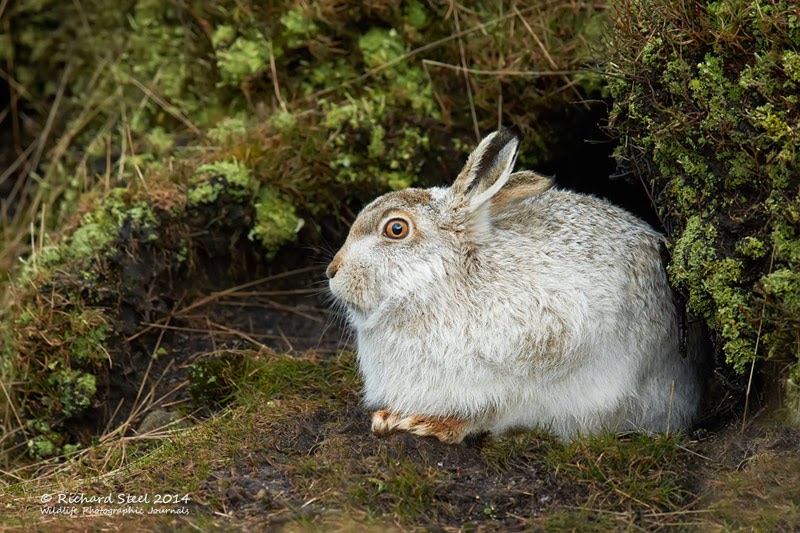
I finally reached the gully and again there were three hares there and managed a few photographs of one of them amongst the rocks. The other two heading rapidly up slope shortly after arrival. The speed of a mountain hare going up a slope is very impressive.
This was to be my last mountain hare of the morning and despite walking around for a while longer, the hares had suddenly become noticeably absent as the sun broke through the cloud layer above. By now it was late morning and I assumed they had taken to resting up in deep cover. It had been a morning of hard work but good fun and was now time to head back to the car. The walk back always seems a lot longer but eased but having just spent parts of the last 3.5 hours with some amazing animals.

Tuesday, February 18, 2014

A Tale of Two Hares

My local Brown Hare site has been ominously quiet over recent months and I was started to get concerned following reports that some youths had taken it upon themselves to shoot them for 'fun' last year. Given the apparent complete absence of hares I wondered if this sad activity had carried on and tipped the numbers over the edge, resulting in extinction of this small population.

I can happily report that over the last couple of weeks the hares have begun to return, although numbers still appear low in comparison to a few years ago. Whether this is the result of the alleged shootings, or a result of a natural cyclic fluctuation in numbers that is common in hare populations and partly driven by the rather atypical climatic conditions of the last few years remains to be seen. What I do know is it is great to see them back and it was a pleasure to put some in front of the camera for the first time this year on my brief session with them a couple of weeks. The sight of the hares reminds me that Spring is not too far off now and hopefully will see an end to the diabolical winter weather we have suffered this year. Below is a selection of photos from the session.

Very early in the morning in low light.
Incoming hare.
A shallow depth of field turning the long foreground grass to mush.
Up close and personal.
Running towards another hare nearby.
Still in their thick winter coats.
Last weekend saw a slight chink in the weather and saw me heading out once more looking for Mountain Hare in the Peak District. I thought it would be nice for readers to be able to compare images of the two hare species. Following a successful session with these upland hares in early January the weather has proved frustrating in preventing a return. I made one visit in the intervening period but the forecast proved very wrong and a complete white out blizzard quickly descended across the plateau. I was very glad I use a good GPS and plot my route as such conditions are incredibly disorientating and potentially dangerous with a steep valley to one side. The conditions cut the session short as I was concerned about the snow on the road where my car was parked. This is a good example if you are going to head off into the mountains always make sure your well prepared and also let someone know where your heading to. 

Wind the clock forward to last weekend, the mountain weather forecast indicated it was going to be windy but the cloud base would quickly lift in the morning. I figured that a 35- 40 mph wind and accompanying wind chill was just about bearable and headed off through the cloud to return to the plateau. The hares on this occasion were quite different in behaviour from my encounters 5 weeks earlier and were very skittish. Part of the cause seemed to be that many had now paired up and frequently when trying to approach one it was not possible to the second one lurking nearby. The second hare would take off taking the target hare with it. Despite the difficult conditions and hare behaviour I managed to get a few more photograph to add to the collection. I am very rapidly turning into a mountain hare addict, a condition for which I hope there is no cure.

A welcome sight at a long trek but difficult to keep the camera on the hare in the buffeting winds on an exposed slope.
Sheltering from those biting uplands winds
Sat amongst the red upland grasses
Starting to pair up for Spring breeding.
When sat in amongst the long grass, despite being white, they can be extremely difficult to spot. This is why on occasions a hare seems to appear as if from nowhere from right by your feet.

Wednesday, February 05, 2014

Down the Road to Purple Sands

I am sure the weather gets worse every winter. As a wildlife photographer the weather, and more importantly the effect it has on the quantity and quality of the light, is everything. Since the start of December low depression driven storms have been rolling continuously in off the Atlantic on an unusually strong jet stream with a day or two of more benign between them.  Occasionally a quiet weather spell has fallen on a weekend day and the camera has got an airing but so far such moments have been few and far between. With the days currently still short in daylight, my only potential camera time is at the weekend and it certainly gets you down when the Friday forecast predicts another weekend of very wet and windy weather to come.

What has been particularly frustrating for me is, having located what seems to be a reasonably good location for Mountain Hares, I have just not been able to get back there. If the weather is poor where I live then you can guarantee it will be doubly dire in the hills.

So given the general lack of action I thought I would delve into my hand drive and catch up with some processing of images that I never got around to sorting out last year. The folder marked 'Wirral Purple Sandpipers' looked a good place to start on the backlog and so this what this post is about.


I am fortunate to have some Purple Sandpipers present during the winter months about 2 minutes from my home.  The photography is undertaken at high tide when the birds sit out and roost on the sea defence rocks and groynes over the high water period. So it is easy when some free time coincides with a high tide and half decent light to pop down the road for a quick half an hour session. Having said that these rock areas are not as reliable for photography as they use to be after a large inaccessible floating pontoon for boating was installed on the local marine lake and where large numbers of waders, including the Purple Sandpipers, now frequently sit for their high tide roost. However, there are benefits for the birds, which is important, as they now have a peaceful place to rest and preserve their precious energy reserves in the winter away from careless dog walkers and kite surfers. Of course being so local it is no big deal if the birds are not present on a particular visit as you know will encounter them at some point on a future one.

A wing stretch


I would really urge photographers to try and learn the good photography locations for their local wildlife. Being local allows you to undertake frequent visits, even if they are brief sessions,  which helps develop a good understanding of the behaviour of a particular animal or bird species and how different photo opportunities present themselves with the changing seasons.  It also allows you to concentrate your efforts towards certain species which brings its own rewards and benefits and  is with time often reflected in the resultant images. The more time you spend with a particular species the more likely you are to capture a special moment or light conditions.

Anyway I digress, back to the Purple Sandpipers. These are a bird I love to photograph. There is something visually very appealing about these birds, the white edged feathers, the very slight purple shimmer to the in the right light, the orange beak and feet all packaged up in a slightly dumpy looking wader. They also share a similar trait to Turnstones in that they are not particularly bothered by the presence of a photographer, especially if you approach them slowly and carefully and sit with them quietly. I consider myself very fortunate to have these birds so close to home and it being relatively easily to spend some time with them during the winter months.
Over the last few years I have accumulated many Purple Sandpiper photographs but it is still a species I find myself drawn back to time and time again. I hope I will be able to spend some more time with them before they depart once again in the spring, assuming the current run of poor weather improves in time.

Sunday, January 26, 2014

Project J Revisited

Regular readers of my blog will recall that I have a long running project to photograph Jays in flight, known as 'Project J' which started back in 2009. I have dipped in and out of this over the intervening years and last weekend thought it about time for a revisit given that conditions looked right.  Typically I arrived too early and before the sun had even crawled up over the horizon but it gave me a few moments to gather my thoughts and think about my approach for the session ahead.

For this session I decided that I was going to try a closer approach using the 300mm F2.8 lens. This lens has very fast autofocus and thought it might help with the erratic nature of the Jays flight path. However, this would of course be offset by the fact that I would be now much closer which means the action is much faster and more difficult for photographer and autofocus to keep in touch with the birds. The easier approach would be to set-up a log or stump and pre-focus on it but I always like a challenge and can assure you that trying to photograph free flying jays is definitely not easy.  Not only are the birds quite erratic in flight but also perform what I call the 'jay flip' on landing which is a bit of mid-acrobatics just before touch down. This can see them flip out of the field of view just at the critical last moment.
Of the three corvids present at this site - crows, magpies and jays, the jay being the smallest is at the bottom of the pecking order which usually means a short wait is required for them to appear. So whilst waiting a did a couple of test shots with the magpies.
The light was all over the place during the session with both sun and overcast conditions which kept me very busy with adjusting camera settings. The long shadows from nearby trees cast by the low winter sun also proved problematic as they moved across my target area as the sun rose. The photography is all done from the car which is not the ideal place to pursue flight photography but is the only way possible with this shy species. I really wish my car had smaller wing mirrors!!
Four Jays eventually appeared and it was time to try and capture some flight images. I decided for this session I would mainly concentrate on the birds coming into land.

The session was reasonably successful although quite a few images ended up in the trash from this session. I am still debating whether using a longer lens at greater distance is a better approach. Of course there are a lot of variables during each individual session which affect the birds behaviour such as wind direction, how many jays are visiting and the interaction with other birds. I doubt I will ever find the magic formula for success beyond perseverance. This is why I keep returning to Project J and am sure this certainly will not be my last session as it is always a pleasure to spend time with these charismatic birds.

Monday, January 20, 2014

Well-timed Waders

When you live by the sea, you seem to become very tuned into the rhythm of the tides.  This is particularly the case as a bird photographer as you learn where various wading birds will be at both different states and heights of tide during the winter. As examples there are some beaches where large accumulations of mixed flocks of waders can be found on spring tides, the gathering of Bar-tailed godwits on a local beach during neap tides or the gathering of curlews on a field the high tide period.
The majority of wader photograph tends to be done towards the top of the rising tide as the birds are pushed towards the waiting photographer. Also the bigger tides tend to be favoured as it reduces the area of beach for the birds to use and make them easier to photograph.  However, having said that on the very big spring tides, rocks where the birds typically roost may be inundated and empty. The other key consideration is light direction. For example the beach (a generous phrase for estuarine mud and rocks in the River Mersey channel at the end of my street) can only be photographed during the afternoon a two to three of hours after high tide.

Living by the sea allows you to learn these patterns and use the knowledge to undertake short productive sessions for photographing the birds. This does not work all the time as on occasions the disturbance by other beach users put the flocks to flight.

On the big spring tides at the beginning of the month the appearance of some low late afternoon winter sun in conjunction with the peak of the tide saw me grabbing the camera and taking the 5 minute journey to a beach on the north of the Wirral peninsula. As I hoped there was a narrow strip of beach remaining with one of favourite waders to photograph, the Sanderling, dashing around foraging along the foamy edge of the waves.

 It was just a question then of sitting quietly nearby and letting the birds come to me which is always the best approach. I soon had the birds literally running around close to my feet speeding along the shore looking for marine morsels brought in by each new wave.  The often made comparison of sanderling to clockwork toys as they run around the beach is a very good analogy. They are great fun to photograph as they sprint up and down the tide line.

I had a good 30 or 40 minutes with the birds until a dog walker thought it was hilarious to let his dog rush around and generally terrorise the flock until all the birds departed.
Wading birds, particularly in the winter, are often on a tight energy budget and disturbance of this sort does nothing for their general welfare. However, you cannot expect the majority of people using the beach and coastal footpaths to realise this and all you can do is try and educate where possible.

As I made my way back to the car I spotted a couple of Dunlin together with a few Redshank standing on the rocks, in the diminishing light trying, to avoid the spray of the waves crashing against them and so a took a few photographs before returning home.

So the total length of this session from leaving home to my teabag landing in the mug when I returned was about an hour. An hour well spent in my opinion, as is any time with waders, and such a short session was only possible due accumulating local knowledge from experience.

Wednesday, January 08, 2014

Hares of the Hills

Firstly a very Happy New Year to you all.

Having spent a lot of time photographing Brown Hares, about 18 months ago my thoughts turned to thinking about trying for their slight smaller upland relative the Mountain Hare. There are two main places to find Mountain Hare which are the Highlands of Scotland and the Peak District, the latter being a population introduced in the 19th century. With the Peak District being reasonably close to home this seemed the sensible place to target my efforts.

The Peak District covers a huge area and so I started some Internet research to try and narrow down my search for the enigmatic hare. However, much of the information I found was not particularly specific until I stumbled across some geo-referenced photographs, albeit from a few years ago. I painstakingly entered the grid reference of every photograph I found into my GPS which resulted in two distinct clusters emerging. It was one of these clusters I decided  to target. Having said all that my first outing for the hares around Christmas time was actually to a completely area having received a suggestion on a place to try. This ended in failure despite trudging across the hills for several hour with not a single hare was seen.

I decided to follow my research and instincts and try my original target area although the first visit did not go well. When I left home the skies were clear but as I approached the Peak District I could see clouds on the hill tops. By the time I finally reach the area where I was going to head out on my trek I was in thick cloud being blown by strong winds and very limited visibility. I waited in the car for a couple of hours hoping it would clear but it was not to be and so returned home hare-less once again. An important lesson was learnt though that I needed to pay a bit more attention to the 'mountain' weather forecast before heading out. I kept my eyes fixed on the forecast waiting for the right conditions before heading out again. Would it be the proverbial third time lucky?

I started heading up hill and was scanning around looking for hares. To be honest having not photographed them before it seemed a bit daunting as I had no idea of what their preferred habitat would be although given their white coat and the lack of snow I thought they should be fairly easy to spot. I could see a white blob on the far side of the valley about a kilometre away. So  I took a photograph and zoomed in on the image on the back of the camera and yes it was a hare and not a plastic bag!

The valley however was steep sided and so I trekked upwards to where it was shallow and I could cross before coming back down to where I had seen the hare. After a bit of sneaking and crawling around in the peat hags I finally had my first hare in the viewfinder.
I had put my bag down to get myself in position to photograph the hare and as I walked back to retrieve it, I just spotted a small amount of white in the grass on the bank above me. After some careful looking this was another hare which I managed to get really close to.
Having now got a close prolonged view of one of the hares I could really see what beautiful animals they are.
There seemed to be a few hares in this area so I decided to spend some time searching around to see if I could find some more. The eroded gullies through the peat meant that in this rough landscape I tended to come across the hares very suddenly and without any warning and sometimes the first I knew about a hare being there would be as it set-off in a long arcing run away from me. If I could see a hare in advance then it became easier to plan a route using the gullies and hummocks as cover to move up close to it.

This one was tucked out of the brisk breeze blowing across the plateau and taking in some sun.
After a while walking around I spotted another hare at distance and again managed to get in close after taking a long route to get in to position. Physically the Mountain Hare are slightly smaller than a Brown Hare but seem to be a very study animal. Both species share similar coloured eyes and the ears on the mountain variety are considerably shorter.
I moved higher up still to another hare I had spotted from a distance.
By this time it was now late morning and I was intending to head up on to an upper plateau but the cloud base suddenly descended shrouding the hilltops in grey murk. So I decided I would make my way slowly back down to the car and see if I could spot any hares en-route. I spotted this one in a peat gully which was to be the last of the morning session.
Overall I was very pleased with how this session went and importantly learnt a good deal about the hares which hopefully will be useful during my next visit. I have to say the large mug of tea and long hot shower I took when I arrived home were most welcome!

LinkWithin

Related Posts with Thumbnails