Showing posts with label Rook. Show all posts

Sunday, November 04, 2012

Simply Rooks

During the autumn and winters of the last three years I have been feeding the Rooks and Jackdaws that can be found on sheep grazed fields that surround my work office car park. This has allowed me to undertake plenty of lunch hour photography sessions when the weather has allowed. It has also been a good source of images for  my long running and intermittent 'corvid in flight' project and has been very enjoyable getting to know the ways of these 'intelligent' birds.
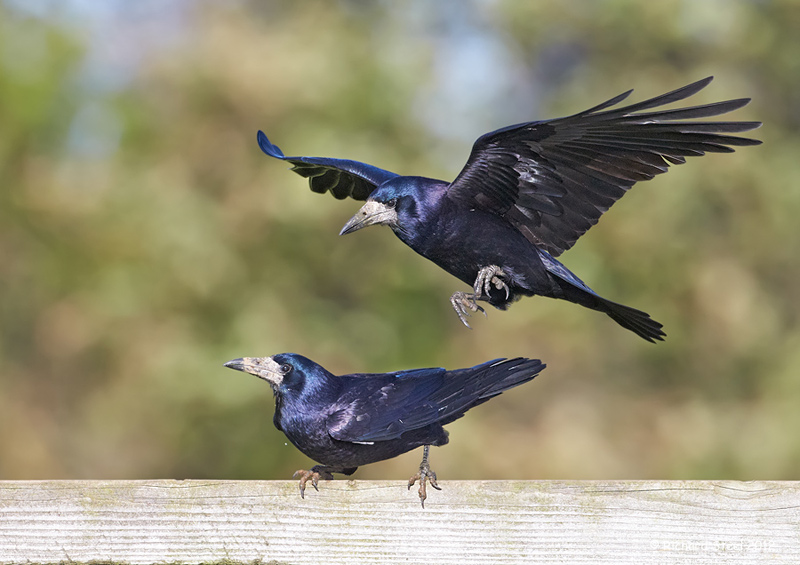
The general impression of a rooks is of a dull black, noisy bird that can be found in muddy farmland during the winter. They are often overlooked by photographers. Having spent many lunch hours with them I have found these corvids to be incredibly beautiful and interesting birds to photograph. For a start they are not black but have a wonderful blue and purple iridescence when the light hits them. They are also great birds to photograph in flight as they form an attractive shape with the long finger like projections of their primary feathers.
I have seen some interesting behaviour amongst the group and the character of individual birds coming through as they descend on my free hand outs. Bold birds, timid birds and displays of pecking order amongst this communal species.
As a bit of insight, a typical lunch hour session would be as follows. First task is to look out the window at the weather, ideally with some sunlight that needs to be combined with a wind from between south to west. This will determine if its a lunch time in front of the computer with a sandwich or one in the car park with the rooks. I have always fed the birds at a similar time of day which has been important as I only have 60 minutes available and need them to arrive quickly. The food is put out on top of the fence at the edge of the car park. Usually at this point there are no signs of the birds nearby with only an occasional one drifting across the fields at distance. After about 10 minutes a lone bird, which I call 'the scout' will fly over and circle above the fence and then disappear for around 5 minutes. When it returns, it brings the flock with it and there is suddenly between 20 and 50 rooks in front of me and the photography can start.
All the photos on this post are a selection of some taken during my lunches on Thursday and Friday last week. You will notice that the birds mostly are facing in the same direction as there was a brisk wind from the south-west during these days.
There is a particular reason why I have shown these photographs. Firstly the rooks were looking stunning in the light on the days and showing off their wonderful colours but also as they may well be some of the last images of my sessions with the rooks.


About 2 months ago it was decided my office would be closed and after next week I am being relocated to Northwich. I will miss the rooks, and all the other birds, such as Dippers, that have filled my lunch hours during my time in North Wales. However, I will make time to visit them occasionaly in the future during weekends and days off. Obviously moving to a new office I will be now on the look out for some new lunch time wildlife photography opportunities and it will be interesting to see what I will find.

Sunday, November 20, 2011

Corvids in Flight

The crow family or corvids gets a bad press. Words often used to describe these beautiful, and 'intelligent' birds include evil, cunning, vicious, sinister and murderous which has not been helped by their general portrayal in newspapers, film and books. They have in my opinion been wrongly accused of the steep and recent decline in UK song birds with inappropriate calls for culling above and beyond their usual daily persecution. In my view the changes and losses in bird habitat and the domestic cat are probably the major influences in small bird decline. In 2006 it was estimated their were 10.3 million domestic cats in the UK which is a large population of efficient predators. Another study showed that cats bring home about 4 small birds a year. I think the resulting maths speaks for itself yet noone obviously calls for a cull of cats. Corvids will take eggs and chicks from nests but then again woodpeckers are more predatory than you may realise. The crow family and song birds and have lived in harmony for thousands of years and common sense would suggest that other factors are at play here in the recent sharp declines of the latter.

Over the last couple of years I have spent many happy hours in their company. They are fascinating birds and the closer views has given me a great appreciation of the subtle beauty of their true colours. From a photography point of view they provide good subjects and often look at their most spectacular when in flight. However, capturing flight images of these birds has proved both challenging yet personally rewarding.

For this post I will concentrate on three species and start off with the Jackdaw. These birds are superb aerial acrobats.
The moment of touch down.
The magpie is a particularly maligned species probably because we have greatest contact with these birds as they visit our parks and gardens. They are particularly tricky to photograph in flight as they tend to be quite erratic. A further challenge is achieving the correct camera exposure on a black and white bird in the good light required to freeze them in flight.
I find that photography of these birds flying is at its easiest just before the point of landing.
My favourite pose for this bird is the head on landing when all the feathers are at full spread to slow the bird on it final approach but in photography terms these images are the most difficult to achieve.
Of course what these images unfrotunately do not show is the the iridescent blues, green and purples that can be only be seen on a dorsal view of these bird.

I will finish this post with some Rook images. This is a particularly overlooked species by bird photographers but I cannot for a moment imagine why. These birds have been a long running subject that I have pursued during my lunch hour at work and I am sure will continue to be so. Some sandwiches, a camera and a flock of rooks is a great way to spend 60 minutes.
I love the purple and blue sheen of these birds when the light hits them at the right angle.
As with the Jackdaws, Rooks are incredibly agile in flight.
The wing shape of these birds, with the long feather 'fingers', is on a par with many raptors and creates some interesting flight poses.
Hopefully this post will have helped you view corvids in a more favourable light For those who wish to find more, can I suggest that you wander over to the excellent Corvid Journal which has a wealth of information on these birds. For those who already share my passion for corvids you may wish to go and check out and help support one of the organisations, such as Corvid Aid, who undertake such brilliant and dedicated work rehabilitating injured birds for release back in to the wild.

Thursday, March 10, 2011

Glimpses of Light

Many of you will have probably guessed from my recent posts that the light, which is the essence of photography, has been in drastically short supply over the past few weeks. There have been the occasional bright days and moments but typically they have coincided with me being otherwise occupied with work. There are few things more frustrating than looking at the sunlight pouring through the office window on a week day only to see the weather suddenly flick to dark grey gloom for the following entire weekend. To try and overcome these light issues and get some photographs taken, I have tried to keep my camera with me as much as possible. This has been mainly to try and stack the odds in my favour when those glimpses of better light do occasionally show. So this Blog post is a compilation of species arising from snatched moments of light since the beginning of the year.

I managed to find a couple of Bar-tailed Godwits at the edge of the ebbing tide at the end of the road where I live. A quick dash down the hill was made as the sun briefly appeared.

A large flock of Bewick's Swans, which are unusual for my local area, gathered on some flooded agricultural fields. These wild swans are a very different proposition for photography than the loaf munching variety on the local park lake. They are very nervous birds and required a careful approach.

While on the topic of swans I stopped briefly on the way home from work last week to find this Mute Swan in the fading embers of sunset. Its good to see the day lengths are slowly starting to draw outwards.

I caught up with one of the Common Buzzards that lurks near the office. Perched in its regular location during a lunch hour last week. They are certainly a species of habit and routine.

I have been keeping up with the various Corvids that I love to photograph and kept my couple of feeding sites going. This has the benefit that the birds quickly appear, after I do, which is ideal for my often very brief visits.
A Jay taking an apparently perilous dive towards the ground.

A rather tatty looking Magpie coming in to land. I suspect this one has had a few run-ins with the local crows. It is interesting at these corvid feeding sites to watch the pecking order between species. At this particular site the order of dominance is crow, magpie and then jay.

A gentle touch-down by a Rook.

There has been an increasing presence of Wood Pigeon at one of the feeding sites. Some of which are starting to look very well fed!

To finish off this post of making the most of limited moments of light, an early morning encounter with a Meadow Pipit on the beach.

The signs of Spring are on the way with the first migrants in the form of Northern Wheatear arriving in the south of the UK heralding the sign of an exciting bird photography days ahead over the next 3 months.

Sunday, February 06, 2011

Corvid Lunch Break

For about the last two years I have been regularly feeding the large flock of Rooks and Jackdaws that use the fields surrounding my office. The feeding site is on the edge of my work car park and so about 100 metres from the office front door. The birds have become very accustomed to both me and the free hand outs which means that they quickly appear when their free lunch appears.

We both benefit from the arrangement as the birds get their diet supplemented and I get an opportunity to break up the office day with a lunch hour of photography which is very therapeutic to relieve the stresses of the morning's work.

Regular readers (that's both of you ;)) will know that I have a great fondness for all the crow family and despite their apparent sinister and destructive reputation it is difficult not to be impressed by the subtle beauty of their metallic sheen, 'intelligence' and social interactions.

As you can imagine the numerous lunch hour sessions over the last two years have provided me with many memorable sights and a good selection of photos. I have mainly concentrated my efforts on taking flight photos.


More recently my attention has been grabbed by the interactions and displays of pecking order as the birds feed.

When faced with multiple birds it always a tricky task to get both birds sharp, well lit and in interesting poses but persistence eventually produces results.

Jousting on the fence...

...and 'dancing' in the air.

I have really enjoyed the lunch hour sessions so far this year. The short time available in a lunch break certainly concentrates the mind on trying to achieve particular types of photographs. I will continue with the corvids for a couple more weeks before my attention will shift to another lunch hour species.

Friday, December 31, 2010

End of the Year

As the weather, but more importantly the light, has been so grim over the last week I have been busy wading through my backlog of images. It is good to have got this finally finished before the end of the year and the double hard drive back-up is whirring away beside me as I type this.


I thought I would use this post to give a quick overview of my year and post a selection of images processed from the backlog. For me it has been a productive photography year with 118 bird species and 5 mammal species photographed including 17 species that have not been in front of the lens previously.

There have been so many wonderful moments shared with wildlife that its hard to pick out some highlights but the three that stand out are:
  • The entire trip to Norway in the summer. Wonderful birds, landscapes and people;
  • A very early morning in Spring, during a visit to Hampshire, which produced three new species in the space of a few hours including an unforgettable encounter with a Dartford Warbler;
  • Photographing Leach's Petrels in severe onshore winds with my friend Steve. Such a privilege to see so many of this ocean wander at such close quarters.

Before posting the last images of 2010, I would like to send the warmest thanks to all those that have taken the time to read the blog and provide feedback. 2011? who knows what may appear in front of the camera but I am looking forward to it already :). So I will wish you all a Happy, Healthy and Successful New Year.

Fieldfare listening for worms below.

Mediterranean Gull in flight

Young Green Woodpecker on a gravestone. These are such a tricky species to photograph and hopefully I will do better with them in 2011.

Common Buzzard photographed by my office during a lunch hour.

Female kestrel who is a regular visitor at one of my sites.

Mute swan

It is amazing how much fun you can have with a large puddle and a flock of starlings.

To finish of some rooks and jackdaw.

I have been putting nuts out for these birds to help through the recent cold weather. I think this photo shows how hungry the birds have become.

Please remember just because the snow may have gone, if you have been feeding the birds, then please continue as they need to rebuild up fat reserves and I am sure we have not seen the last of the cold weather this winter.

LinkWithin

Related Posts with Thumbnails